 By Admin
 I Tried Whipping a Cold Can of Evaporated Milk Instead of Heavy Cream. Here’s What Happened After 10 Minutes
Heavy whipping cream is the gold standard in baking for a reason. Whisk it right, and you get thick, glossy peaks perfect for topping just about any dessert.
But every home cook knows the panic of opening the fridge mid-recipe and finding no cream in sight. That’s exactly where I landed one evening — no heavy cream, but a can of evaporated milk sitting in my pantry.
That got me wondering about a trick I’d seen floating around online: can evaporated milk actually be whipped into something resembling real whipped cream? I decided to find out myself, armed with a whisk, a chilled can, and ten minutes to spare. Here’s how it went.
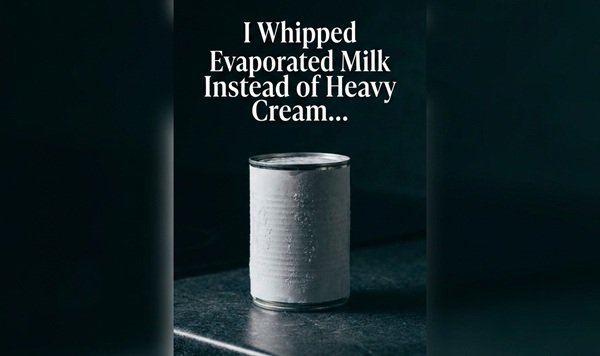
Why Evaporated Milk Seemed Worth a Shot
This wasn’t some elaborate plan — it was necessity meeting curiosity. No cream, but a lone can of evaporated milk in the cupboard.
Evaporated milk is just regular milk with roughly 60% of its water cooked out, leaving it thicker and shelf-stable. It’s a pantry staple for adding creaminess to soups and casseroles. But it doesn’t have anywhere near the fat content of heavy cream, so I wasn’t optimistic. My theory: maybe freezing it cold enough would help it trap air the way whipped cream does.
Getting Everything Ice Cold First
I wanted to give this a fair shot, so I stuck the unopened can in the coldest part of the freezer for 30 minutes — cold enough to chill thoroughly, not so long it froze solid.
I also tossed my metal mixing bowl and whisk attachment in the freezer alongside it. Bakers do this with real cream to help it whip up faster and hold its shape, so I figured it couldn’t hurt here either.
The First Few Minutes
Once I poured the milk into the frozen bowl, the difference from heavy cream was obvious right away — it looked thin and watery, nothing like cream’s thick pour.
I switched the mixer on anyway. For the first minute or two, nothing much happened besides the liquid sloshing around. Then a light froth started forming on top. By the two-minute mark, the mixture had lightened and filled with tiny bubbles. It wasn’t much, but it was something, and I kept going.
Five Minutes In: Foam, Not Cream
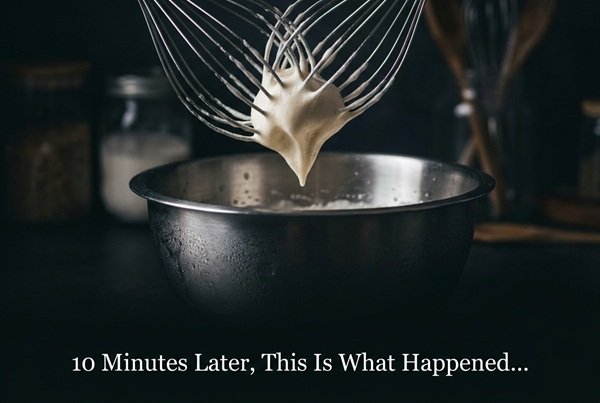
At five minutes, the milk had puffed up noticeably and turned frothy — but it looked more like cappuccino foam than whipped cream.
Lifting the whisk out gave me soft little peaks that collapsed almost instantly. The whisking was clearly adding air, but the milk had nothing to hold that air in place.
Ten Minutes: Still Not There
By the full ten minutes, I’d mostly given up hope of real peaks forming. The mixture had thickened slightly since the five-minute mark, but it was still a loose, delicate foam — not the sturdy structure I was after.
No amount of extra whisking changed that. The milk simply didn’t have what it needed to hold its shape.
Testing the Texture
Scooping it with a spoon gave me soft peaks that melted back into liquid within seconds. It felt light on the tongue but had zero staying power.
Left sitting on the counter, the foam started separating almost immediately, with a thin layer of liquid pooling at the bottom. Whatever volume I’d built was clearly temporary — not something you’d want on a cake or pie.
How It Tasted
Flavor-wise, it was mildly sweet with a touch of dairy richness, but nowhere near the smooth, indulgent taste of real whipped cream. There was also a noticeable canned-milk flavor throughout — not bad exactly, but distinct enough that it could clash with more delicate desserts.
Comparing It to Real Whipped Cream
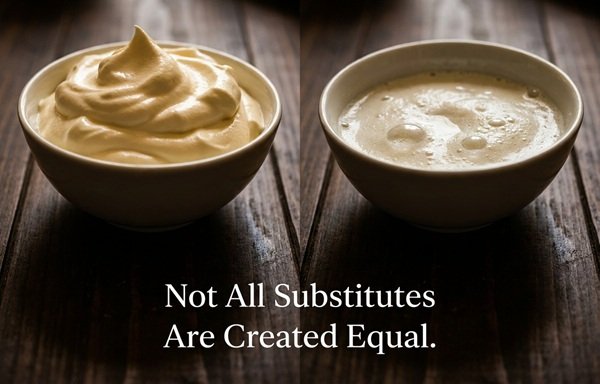
Set side by side, the difference was impossible to ignore. Real whipped cream holds firm, glossy peaks for hours and tastes rich and full. My evaporated milk version was pale, airy, and thin — a decent froth, but nothing close to a true substitute.
The Science Behind Why It Doesn’t Work
It comes down to fat content. Heavy cream is about 36% milk fat, which forms a strong network that traps air and holds peaks in place.
Evaporated milk only has around 6-8% fat — nowhere near enough to build that same structure. The whisking adds air just fine, but without enough fat to lock it in, the bubbles collapse almost as fast as they form.
When This Trick Is Actually Worth Trying
This works fine if you just want a light, foamy topping for coffee or hot chocolate — something casual that doesn’t need to hold its shape.
But for actual desserts — cakes, pastries, pie toppings — it falls short. It just can’t provide the texture or stability those need.
If You’re in a Pinch, Try These Instead
A few tweaks can help if evaporated milk is truly your only option:
- A splash of lemon juice can help tighten the milk proteins slightly
- A spoonful of dissolved gelatin can add some stability to the foam
Better yet, skip evaporated milk altogether and reach for chilled full-fat coconut cream, which whips up thick and creamy, or thick Greek yogurt, which holds its shape well and adds a pleasant tang.