 By Admin
 I had never been there for any of my daughter’s graduations.
Not kindergarten. Not middle school. Not high school.
While other fathers were standing beside their daughters, taking pictures and watching them walk across a stage, I was somewhere else. Sometimes I was in a bar. Sometimes I was in a cell. Other times I was out riding with my motorcycle club.
My daughter’s mother had photographs from every important ceremony. In almost none of them was I there.
My name is Dale. I’m sixty-four years old, and for most of my forty-one years riding with the same motorcycle club, I was a terrible father.
I won’t make excuses for that.
When Casey was nine, her mother, Lynn, left. I wish I could say that was the moment I changed, but it wasn’t. I got worse. Eventually, I was arrested and spent time in a Marion County cell, where I finally got sober with nothing but my own thoughts to keep me company.
When I got out, Casey was twelve.
She treated me like a salesman standing on her porch.
And honestly, I deserved it.
I didn’t win her back with one emotional speech. There was no miracle moment where everything suddenly became perfect.
It happened slowly.
I started showing up.
School pickups. Flat tires. Small favors. Quiet moments.
When she wasn’t ready for me to sit in the stands at her softball games, I waited in my truck outside.
I kept showing up.
Years passed before she started calling me Dad again instead of Dale.
By the time she was twenty-four, Casey knew exactly what she wanted to do with her life.
She wanted to become a nurse.
The reason was simple.
When her grandmother was dying, a night nurse named Brenda had treated her with kindness and dignity when she needed it most.
Casey never forgot that.
She entered nursing school at twenty-six while working during the day, attending classes at night, and completing clinical hours on weekends.
I remember sitting at my kitchen table while she studied wound care from a textbook. Sometimes she’d fall asleep with the book still open.
I was unbelievably proud of her.
She was going to become the first person in our family with a degree.
Then, last October, my back started hurting.
I assumed it was just the years catching up with me.
It wasn’t.
The doctors found pancreatic cancer.
Stage four.
It had already spread to my liver.
The doctor was kind enough not to give me false hope.
“Months,” he said.
Not years.
Months.
I went home and did what I needed to do.
I sold my truck. I handled my paperwork. And I told only three people.
Ray.
Hoss, the president of my club.
And Casey.
I remember telling my daughter while we sat outside the veterinary clinic where she worked.
At first, she didn’t cry.
She became a nurse instead.
She started asking questions about staging, treatment options, second opinions and everything else she could think of.
Then her pen stopped working.
She shook it.
Tried again.
And when it still wouldn’t write, she put her head down on the steering wheel and finally broke.
There was nothing I could do except watch my little girl fall apart.
A couple of weeks later, she came to see me at the hospice.
She told me she was thinking about leaving nursing school.
“I have three months left,” she said. “I can finish next year. I can defer.”
“No.”
She looked at me.
“I’m not going to sit in a pharmacology lecture while you’re—”
She couldn’t finish the sentence.
I raised my voice.
I told her that seeing her walk across that stage was one of the only things keeping me going.
I told her that if she quit school because of me, then everything I had spent the last fifteen years trying to teach her meant nothing.
My whole goal had been to make sure her life became bigger than mine.
She promised she would finish.
Neither of us said what we were both thinking.
Graduation was May 16.
I didn’t think I would live that long.
Then I discovered something Casey had been hiding.
She still owed $9,400 for tuition and fees.
Her scholarship had covered much of her education, but not everything. She had been working extra hours at the veterinary clinic to make up the difference.
She looked exhausted.
Gray.
She never complained to me.
One evening, while she was getting coffee at the hospice, she accidentally left her laptop open.
The school billing page was on the screen.
Payment schedule.
Monthly amounts.
And a warning that her account would be placed on hold if the balance wasn’t paid before graduation.
I stared at that screen for a long time.
I had $9,400 left in something I owned.
My 1987 FXR.
I’d had that motorcycle for thirty years.
I rebuilt the engine twice myself.
Casey learned how to count while sitting on that motorcycle’s tank and pointing at the gauges.
That bike had been with me through Lynn leaving, getting sober, losing my father and trying to become a better man.
In our club, every man knew that motorcycle.
Hoss had tried to buy it from me twice.
I always told him I’d be buried on it.
But Casey needed her degree more than I needed the bike.
So one afternoon, while the nurses thought I was sleeping, I made a phone call.
A collector from Louisville had wanted the motorcycle for years.
I gave him a price.
He didn’t negotiate.
While Casey was in class, Ray’s nephew—someone I trusted—took the motorcycle out of my garage.
The money arrived in an envelope.
I hid it beneath my mattress.
Casey never knew.
A few days later, I told Ray about my wish to see my daughter graduate.
He didn’t say much.
That should have warned me.
Ray had been my brother for forty years.
I knew that silence.
It meant he was planning something.
Saturday morning, the nurses dressed me without telling me why.
They put my cut over my hospice clothes and wheeled my entire bed toward the doors.
Then I heard it.
Motorcycles.
Dozens of them.
The sound rolled through the parking lot like distant thunder.
When we reached the sunlight, I saw two perfect rows of motorcycles stretching down the parking lot.
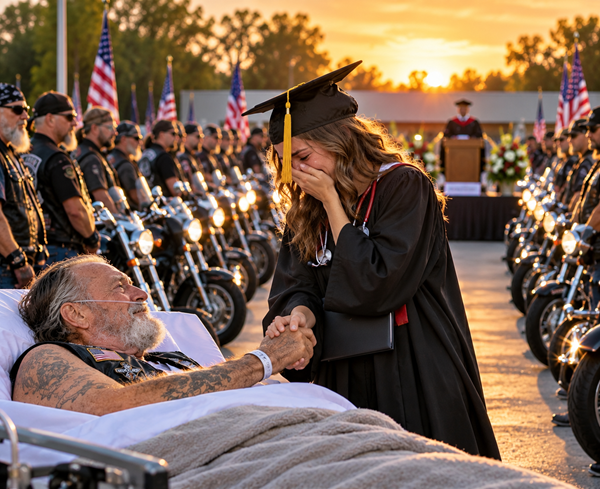
There were sixty of them.
At the end was a podium.
My brothers stood beside their bikes.
Then I saw her.
Casey.
She walked out of the building wearing a graduation cap and gown.
Her hands covered her mouth.
Her mascara was gone.
Ray bent down beside my bed.
“You’re not missing this one, brother.”
That’s when forty years of never crying in front of those men disappeared.
Casey slowly walked between the motorcycles so I could see every step.
The dean called her name.
“Casey Lynn Prewitt.”
“Candidate for the degree of Bachelor of Science in Nursing.”
She walked forward and received her diploma.
Then I reached beneath the blanket.
I pulled out the envelope.
“Baby, stop.”
She looked at me.
“You need to see this before you take that.”
The entire parking lot became quiet.
I handed her the envelope.
She opened it.
She counted the money with her thumb.
Then her expression changed.
She knew exactly what it meant.
“Dad…”
She looked toward me.
“Where’s the bike?”
I smiled.
“Exactly where it should be.”
She didn’t understand.
“Paying for the life of my child.”
“No,” she whispered.
Tears ran down her face.
“No, no… you loved that bike.”
I looked at her.
“I love one thing.”
I pointed toward her.
“It’s got a cap on its head.”
She broke down.
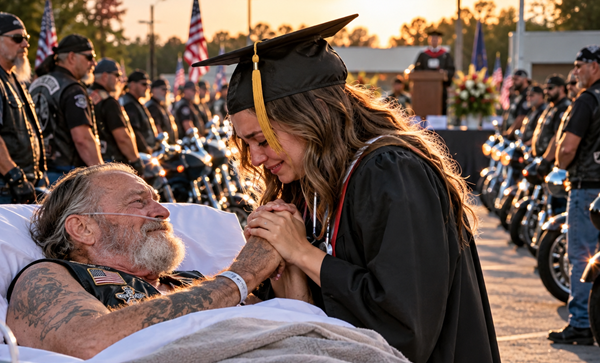
She rested her head carefully against my chest, making sure not to disturb my lines and port.
And for the first time in a very long time, I got to hold my daughter on the day she graduated.
The dean waited.
Then the ceremony continued.
Casey received her nursing pin between two rows of Harleys while sixty motorcycle club members cheered loudly enough to set off a nearby car alarm.
I thought that was the end.
It wasn’t.
Hoss walked over to my bed.
“Dale,” he said quietly, “you know we can’t keep doing this.”
“Doing what?”
He walked toward something covered with a tarp.
Then he pulled it away.
My FXR.
My motorcycle.
My real motorcycle.
The same bike I thought I had sold.
I couldn’t speak.
Neither could Casey.
Then I learned the truth.
There had never been a Louisville collector.
The man who had called me was one of our brothers from the Evansville chapter.
He had pretended to be a buyer.
For an entire month, sixty men had quietly contributed money.
One brother sold a snowmobile.
Others gave up parts of their paychecks.
They raised exactly $9,400.
They knew I would never accept charity to pay Casey’s tuition.
They also knew that if I believed she needed the motorcycle, I would sell it without hesitation.
So they let me sell it.
Hoss looked at me.
“You stubborn old mule. We didn’t give you money.”
“We bought your bike.”
Then he turned to Casey.
“Now it’s yours.”
The title was inside the saddlebag.
“Half the men here learned to ride from your dad,” Hoss told her. “It’s time someone taught you.”
I couldn’t speak.
Casey couldn’t either.
I had been given another seven weeks.
Seven more than the doctors expected.
Casey stayed with me until the end.
She had the hands of a nurse by then, and the hospice staff trusted her because she understood exactly what I needed.
Her nursing pin was on her collar.
Her mother’s face told me it was okay to let go.
Those were among the last things I remember seeing.
In June, Casey passed her nursing boards on her first attempt.
She now works nights on an oncology floor.
She says she learned from Brenda, the nurse who cared for her grandmother, and from the seven weeks she spent beside me.
She says the people who need help the most are often the ones who wake up at three in the morning.
And every Sunday, when the weather is good, people in my old neighborhood say they hear a slow motorcycle pass by.
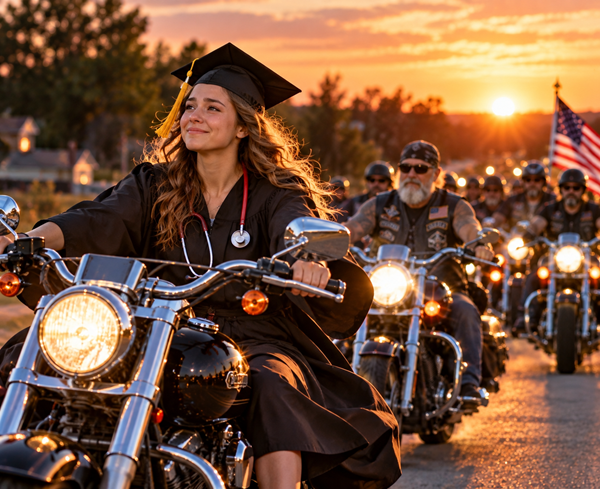
An ’87 FXR.
Casey keeps riding.
She doesn’t stop.
She just passes by.
And Ray follows behind her.
He always will.
Casey never framed her diploma.
It still sits inside the cover the dean gave her that afternoon in the parking lot.
On the wall in her hallway hangs one photograph from that day.
A dying father in a hospice bed.
Two rows of sixty motorcycles.
A young woman in a graduation gown resting her head against her father’s chest.
And somewhere in that picture is the envelope that changed everything.
Neither of us ever let go.