 By Admin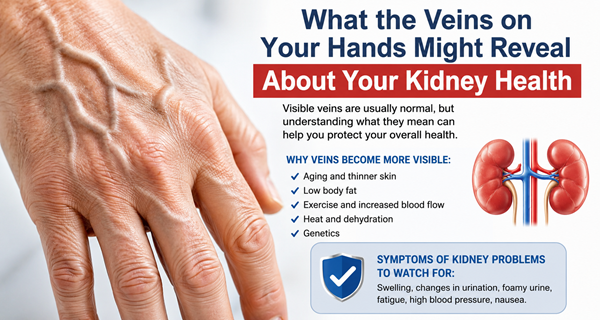
Have you ever looked down at your hands and noticed the veins appearing more raised or visible than usual? It’s easy to wonder if they’re trying to tell you something about your health. One claim that frequently circulates online is that prominent hand veins may be an early warning sign of kidney disease.
But is there any truth to it?
Let’s take a closer look at what medical experts actually know.
Why Hand Veins Become More Visible
In the vast majority of cases, visible veins are completely normal and have nothing to do with kidney problems. Several everyday factors can make the veins in your hands stand out more, including:
- Aging, as the skin naturally becomes thinner and loses collagen
- Having a lean body with less fat beneath the skin
- Genetics, since some people naturally have more noticeable veins
- Exercise, which temporarily increases blood flow
- Warm temperatures that cause blood vessels to expand
- Mild dehydration, which reduces fluid volume and makes veins appear more prominent
As we age, the skin loses some of its thickness and elasticity. At the same time, the layer of fat beneath the skin becomes thinner, making veins easier to see. People with naturally slender hands often notice this even more.
By itself, having visible veins is considered a normal variation—not a sign of kidney disease.
How Kidney Disease Usually Shows Itself
Your kidneys perform several essential jobs every day. They filter waste from your blood, balance fluids, regulate blood pressure, and maintain healthy electrolyte levels.
When kidney function begins to decline, symptoms typically develop gradually. Common warning signs include:
- Swelling in the feet, ankles, hands, or around the eyes
- Constant fatigue or weakness
- Changes in urination, including frequency or amount
- Foamy urine caused by excess protein
- High blood pressure
- Poor appetite or nausea
Notice what’s missing from this list: visible hand veins.
Kidney disease is not known to make veins more noticeable.
Hydration Plays a Bigger Role Than Kidney Disease
One reason people sometimes confuse visible veins with kidney issues is because both involve the body’s fluid balance.
Healthy kidneys help regulate how much fluid stays in your body. When the kidneys are not working properly, fluid often builds up, leading to swelling. That swelling can actually make veins less noticeable.
Dehydration has the opposite effect. When you’re slightly dehydrated, your blood volume temporarily decreases, making veins appear more prominent beneath the skin.
In simple terms:
- Fluid retention often makes veins harder to see.
- Dehydration can make veins stand out more.
Neither situation alone indicates kidney disease.
The One Kidney-Related Exception
There is one circumstance where prominent arm veins are connected to kidney disease—but not because the disease causes them.
People with end-stage kidney failure who require dialysis often undergo surgery to create an arteriovenous (AV) fistula. This procedure joins an artery and a vein, allowing blood to flow more efficiently during dialysis treatments.
Over time, the vein becomes:
- Larger
- Stronger
- More visible
- Slightly raised
These enlarged veins are the result of the dialysis access procedure—not a symptom of kidney disease itself.
Symptoms You Shouldn’t Ignore
If you’re concerned about your kidney health, pay attention to symptoms that doctors actually associate with kidney disease, such as:
- Persistent swelling
- Changes in urination
- Foamy, dark, or bloody urine
- Ongoing fatigue
- High or difficult-to-control blood pressure
- Shortness of breath
- Unexplained nausea or loss of appetite
If your visible veins are accompanied by pain, redness, warmth, sudden swelling, or changes in skin color, the cause is more likely related to a circulation or vascular problem and should be evaluated by a healthcare professional.
The Bottom Line
Prominent veins on your hands are usually nothing to worry about. In most cases, they’re simply the result of normal aging, genetics, body composition, exercise, temperature, or hydration.
They are not considered a reliable sign of kidney disease.
The only way to accurately assess kidney function is through medical evaluation, which may include:
- Blood tests to measure creatinine and estimate kidney function (eGFR)
- Urine tests to check for protein or other abnormalities
- Blood pressure monitoring
- An examination by a healthcare provider
Your hands can reveal clues about aging, circulation, and hydration—but they cannot diagnose kidney disease. If you’re concerned about your kidney health, proper testing is far more reliable than judging the appearance of your veins.