 By Admin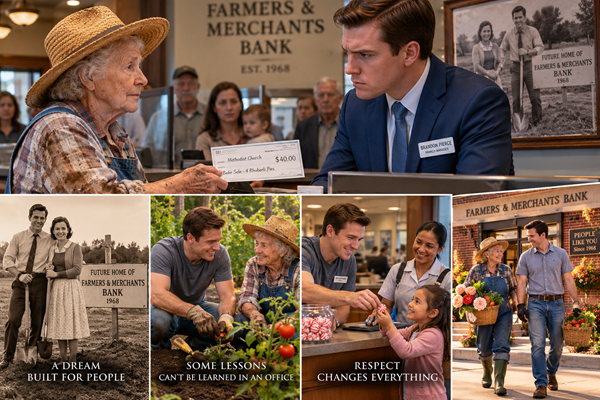
The Bank Manager Refused to Cash My $40 Check Because of How I Looked—Then I Asked Him to Look Up Account 0001
It was a Tuesday morning in June when I walked into Farmers & Merchants Bank wearing my gardening clothes.
I had dirt on my knees, soil beneath my fingernails, George’s old straw hat on my head, and my favorite green rubber boots on my feet.
I had spent the morning tending my tomatoes and had stopped by the bank on my way home to cash a check for forty dollars.
It was payment from the Methodist church for four rhubarb pies I had baked for their annual bake sale.
Nothing unusual. Nothing complicated.
I had been banking at Farmers & Merchants in Millbrook for fifty-eight years.
I never imagined that cashing a forty-dollar check would turn into a day I would remember for the rest of my life.
A Young Manager With Very Little Respect
Usually, Shelly Haskins worked the teller window.
Shelly had been there for twenty-eight years. She knew my late husband, George, and had even attended his funeral. Every time I visited the bank, she asked about my roses.
But Shelly wasn’t there that morning.
Instead, a young man in an immaculate blue suit stood behind the counter.
His name tag read BRANDON PIERCE — BRANCH MANAGER.
Brandon had transferred from the city two months earlier. Corporate headquarters had sent him to manage the little bank, and people around town had already begun talking about his new policies.
He had removed the peppermint bowl from the counter because he considered it unhygienic. He had questioned customers withdrawing their own savings. He had introduced paperwork for transactions that had never required it before.
I had heard the complaints but assumed people were exaggerating.
I was about to discover otherwise.
I slid my check beneath the glass.
“Good morning. I’d like to cash this, please.”
Brandon glanced at the check.
Then he looked at my boots.
His eyes moved to my straw hat, my dirt-stained shirt, and my hands.
Finally, he leaned toward the glass and spoke loudly and slowly.
“MA’AM. DO YOU HAVE AN ACCOUNT WITH US?”
“I do,” I replied.
“I’LL NEED TO SEE SOME IDENTIFICATION.”
I handed him my driver’s license.
I’m seventy-nine years old, and my hearing is considerably better than his manners.
He examined my license, held it up to the light, and turned it over.
Then he looked at me again.
“I’ll need two more forms of identification.”
I stared at him.
“Two more? For forty dollars?”
“A utility bill. A passport. Something showing your address.”
“Young man, I live four blocks from here. The yellow house on Elm Street, with the roses.”
He placed my driver’s license on his side of the counter.
He didn’t return it.
Then he said the words that made the entire lobby go silent.
“Ma’am, we have to be careful with people like you.”
People like me.
I wondered what he meant.
Old people? Poor people? People with dirt on their boots? Widows who still wore their husbands’ old clothes?
Behind me, a young mother stopped bouncing her toddler. At the loan desk, an elderly employee put down his pen. Even the security guard looked uncomfortable.
Everyone had heard him.
I wanted to give Brandon a piece of my mind.
But my late husband, George, had always told me that raising your voice only gave the other person an excuse to ignore you.
So I stayed quiet.
Instead, I looked toward the old photograph hanging near the entrance.
It showed a young man and woman standing in an empty lot in 1968. They were dressed in their Sunday best, each holding a shovel.
Behind them was a wooden sign:
FUTURE HOME OF FARMERS & MERCHANTS BANK.
Nobody paid much attention to that photograph anymore.
But I did.
Because the young woman in that picture was me.
And the young man beside me was George.
The Account Number That Changed Everything
George and I had started Farmers & Merchants Bank in 1968.
We were barely in our twenties, with little money and a big idea: our town deserved a bank that understood ordinary working people.
George had watched large banks turn away honest farmers simply because their clothes were dirty, their hands were rough, or their farms didn’t fit neatly into a spreadsheet.
He believed a person’s character mattered more than the appearance of their boots.
Our first account belonged to George and me.
We deposited $112, almost everything we had left from our wedding.
That account became Account Number 0001.
For decades, George ran the bank according to the principles that had inspired us to start it. He made loans to struggling farmers, helped young families establish themselves, and gave people a chance when other institutions refused.
During the farm crisis of the 1980s, he even risked our own home to help keep the bank afloat and prevent local families from losing their farms.
George believed that a bank was more than a building full of money.
It was a promise to the community it served.
He died in 2017, but I never forgot that promise.
In 2015, when financial pressures forced us to sell a majority interest in the bank to Heartland Bancorp, George insisted on one unusual condition in the merger agreement.
He wanted to protect the future of our local branch.
Buried in the agreement was a provision giving the holder of Account 0001 certain rights over the Millbrook branch, including the ability to prevent its closure or reduction in staffing without written consent.
The agreement also protected ownership of the bank’s building.
The corporate lawyers had agreed to the provision, apparently believing it was a sentimental detail rather than a significant restriction.
George knew better.
“Names die,” he once told me. “Accounts don’t. Somebody will always be able to stand up for this town.”
After his death, Account 0001 passed to me.
I had never needed to use those special rights.
Until that Tuesday morning.
I turned back toward Brandon.
“I appreciate careful,” I told him.
He looked surprised.
“Would you do one thing for me before I go home to get the rest of my papers?”
He sighed impatiently.
“What?”
“Would you look up account number 0001?”
He started to object, but I reminded him that it was my account and that he already had my identification.
Finally, he turned to his computer.
He typed the numbers.
Zero. Zero. Zero. One.
Then he pressed Enter.
His fingers stopped moving.
He stared at the screen, scrolled down, and then back up.
His expression changed.
First confusion.
Then disbelief.
Then something that looked very much like fear.
He glanced at me, then at the computer, and finally at the old photograph on the wall.
His face went pale.
He picked up the telephone and began dialing with a trembling hand.
I knew then that George had left something behind that Brandon had never expected to find.
But I had no idea how much trouble this young manager had already caused.
The Truth Behind the Bank’s Planned Closure
Brandon spoke quietly into the telephone at first.
Then his voice rose.
“Yes, I’m looking at Section 14.3 right now. It’s flagged on the account.”
He paused.
“She’s standing right here.”
Another pause.
“I didn’t know about the covenant. Nobody told me.”
Then he said something that made my stomach tighten.
“I understand. But the notices are already prepared. Shelly Haskins and Harvey Kessler were both informed last week. The branch closure announcement was scheduled for July first.”
I stood perfectly still.
Shelly was being laid off.
Harvey, who had worked at the bank for decades, was being laid off too.
And the bank itself was scheduled to close.
The customers of Millbrook would have to travel thirty miles to another branch or depend on online banking, something many of our elderly residents could barely use.
Brandon had been sent to implement the plan.
When he finished the call, I asked him directly.
“Are you closing this bank?”
He didn’t answer.
“And you’ve fired Shelly?”
“It’s a restructuring,” he muttered. “It’s not personal.”
“She’s been serving this community for twenty-eight years. Her husband is on disability, and she helps care for her grandson. Tell me again how that isn’t personal.”
He looked down.
I asked about Harvey, who had learned of the planned closure only days earlier.
He explained that customers would be expected to use the branch in Oak Ridge, thirty miles away.
“Half our customers don’t have internet access,” Harvey said quietly. “Some of them still use flip phones.”
That was when Brandon’s telephone rang again.
He answered and listened.
Then he held the receiver out toward me.
“The president of Heartland Bancorp wants to speak with you.”
I took the phone.
“This is Dorothy Whitaker.”
The man on the other end introduced himself as Richard Hale, the company’s president.
He sounded shaken.
“Mrs. Whitaker, I’ve just reviewed the merger agreement. I wasn’t aware of the restrictions in Section 14.3. There has been a serious mistake.”
“Yes,” I replied. “There has.”
He explained that the branch had been marked for closure because its transaction volume was low and its operating costs were high.
Brandon had been sent to carry out corporate instructions.
Mr. Hale was driving to Millbrook immediately.
Before ending the call, I made one request.
“Bring Shelly’s job back with you.”
Then I returned my driver’s license to my pocket and looked at Brandon.
He offered to cash my check.
I shook my head.
“No, thank you. I’ll wait for Shelly.”
Then I walked out of the bank in my muddy boots.
Four Hundred and Twelve Letters
Richard Hale arrived at my house that afternoon.
He brought Brandon with him.
And in the back seat was Shelly, who burst into tears as soon as she saw me.
She rushed up the porch steps and wrapped her arms around me.
“They told me I have my job back,” she sobbed. “Dot, what did you do?”
“I didn’t do anything,” I told her. “George did. A long time ago.”
We sat on the porch with iced tea while Mr. Hale explained the situation.
The closure had been canceled. Shelly and Harvey would return to their jobs.
But I wanted him to understand something more important than the language in a contract.
I went inside and returned with an old shoebox filled with letters.
There were 412 of them.
Over the years, families had written to George and me to tell us what the bank had meant to them.
One letter came from a farmer whose family had kept its land because George had given him time to recover from the farm crisis.
Another came from a young woman who had opened a hair salon after starting with almost nothing.
Another came from the family behind Casa Ruiz, a Mexican restaurant that had survived for decades after other lenders had refused to finance it.
Each letter told a different story.
Together, they told the story of Millbrook.
“This bank isn’t just a number on your spreadsheet,” I told Mr. Hale. “It’s part of the reason this town is still here. When other banks said no, George gave people a chance.”
Mr. Hale looked through the letters without speaking.
Brandon sat quietly on the porch steps.
Finally, he apologized.
But I asked him a question.
“Are you sorry because you got caught, or are you sorry because you did it?”
He opened his mouth, then closed it.
“I don’t know yet,” he admitted.
It was the first honest answer I’d heard from him.
So I invited him to sit down.
I asked about his childhood, and he told me about growing up in Chicago with his mother and grandmother.
His grandmother had worked nights cleaning offices for thirty-one years. Once, when Brandon was eight, she had taken him to a bank to cash her paycheck.
She was still wearing her work uniform and bleach-stained sneakers.
The teller treated her with suspicion, demanded extra identification, and eventually had security escort them out.
On the bus home, his grandmother told him that if he worked hard, went to college, and wore a suit, people would treat him differently.
Brandon had never forgotten that experience.
He had worked hard, earned a scholarship, and entered the banking industry determined never to be like the teller who humiliated his grandmother.
But somewhere along the way, he had become exactly what he once hated.
He had looked at my dirty boots and forgotten the person wearing them.
“I did to you exactly what they did to her,” he whispered.
“Yes,” I said gently. “You did.”
Then I told him something I hoped he would remember.
“Your grandmother had working hands. Thirty-one years of cleaning offices at night. She deserved to have her paycheck cashed without being humiliated.”
I paused.
“You don’t owe your grandmother a nice suit, Brandon. You owe her a bank that would have cashed her check.”
He began to cry.
For the first time, I believed he understood.
Five Conditions for a Second Chance
Mr. Hale offered to resolve the situation by canceling the closure and restoring the employees’ jobs.
But I had another request.
I didn’t want Brandon fired.
I wanted him to learn.
So I proposed five conditions.
First, Shelly would return to her position with a raise. She had spent nearly three decades serving the community and deserved to be recognized for it.
Second, Harvey would return to his job and be allowed to retire when he chose, rather than when a spreadsheet dictated.
Third, the peppermint bowl would return to the counter.
Mr. Hale laughed at that one, but agreed.
Fourth, Brandon would work the teller window one day each week in casual clothes, serving customers face-to-face instead of managing everything from behind his office desk.
And fifth, every Saturday morning throughout the summer, he would come to my house and help me in the garden.
“My knees aren’t what they used to be,” I explained. “The tomatoes are getting away from me. And I think you could use a little dirt on your hands.”
Brandon agreed.
The following Saturday, he arrived wearing jeans, a gray T-shirt, and inexpensive white sneakers.
He knew absolutely nothing about gardening.
He mistook tomato suckers for useful branches and pulled up half a row of carrots thinking they were weeds.
By the third Saturday, he had stopped apologizing for every mistake.
By the fifth, he could tie up tomato plants without asking for help.
And by the eighth, he had dirt beneath his fingernails that didn’t disappear on Monday morning.
He also began working the teller window every Thursday.
At first, customers didn’t recognize him in his casual clothes. Some even asked to see the manager.
“I’m the manager,” he would tell them.
Gradually, he began to understand what it felt like to be judged by appearances.
He listened more carefully. He learned customers’ names. He visited local farms and asked farmers to explain their work.
He restored the peppermint bowl and worked with the bank’s compliance department to simplify identification procedures for established customers where policy allowed.
Small changes began to transform the atmosphere inside the bank.
The place started feeling like a community institution again.
And in August, I finally brought Shelly her usual bunch of Peace roses, wrapped in wet newspaper.
She placed them in a coffee can beside the peppermint bowl.
When I handed her my forty-dollar check, she cashed it with a smile.
“How are the tomatoes this year, Dot?”
“Better than ever,” I replied. “I’ve got help now.”
The Future of Account 0001
By the end of the summer, I had begun thinking about the future.
George had always intended for Account 0001 to remain in the hands of someone who could protect the bank and the people it served.
But my daughter lived in Seattle. She loved Millbrook, but she didn’t live here or know the people who depended on the bank every day.
The responsibility needed to stay with the community.
So I contacted our lawyer and created the Millbrook Community Trust.
I transferred Account 0001, its associated rights, and ownership of the bank building into the trust.
The trust would be governed by seven local residents, representing the people who made Millbrook what it was.
The board included Shelly, local business owners, a farmer, a minister, a young mother, and one particularly outspoken gentleman named Earl Lindquist.
The seventh seat would belong to whoever served as branch manager, provided that person actually lived in Millbrook.
I signed the papers in September, sitting in my garden in George’s old hat and my green rubber boots.
Brandon watched as the documents were finalized.
“What happens now?” he asked.
“That’s up to you,” I told him.
His year as branch manager would soon be over, and Mr. Hale was expected to offer him a promotion back in Des Moines.
The promotion would mean more money, a bigger office, and a prestigious title.
But staying in Millbrook would mean something different.
He would have to become part of the community he served.
He would have to live among the people whose financial lives he helped shape.
And he would have to help protect the institution he had once been prepared to close.
I didn’t tell him which choice to make.
He had to decide for himself.
The Woman in the Bleach-Stained Sneakers
Winter came, and the garden went quiet.
Brandon continued visiting, helping me prepare the beds for the following spring.
One afternoon, he told me that his grandmother had died shortly before he arrived in Millbrook.
He had been angry, grieving, and eager to prove himself. He had wanted to be the person on the powerful side of the counter.
“I wanted to be the one who decided,” he admitted.
“There isn’t a powerful side of the glass,” I told him. “There’s just glass. And people on both sides of it.”
In April, Brandon made his decision.
He turned down the promotion.
Instead, he rented a small white house three blocks from the bank and planted his first vegetable garden.
He made plenty of mistakes, but he kept trying.
He also restored the old photograph of George and me standing in the empty lot in 1968.
He placed it in a solid oak frame and hung it prominently on the bank’s back wall.
Around it, he added photographs of local farmers, shopkeepers, restaurant owners, and customers.
People in their work clothes.
People with flour on their aprons, grease on their hands, and dirt on their knees.
There were sixty-three photographs by the time he finished.
Above them, he placed a small brass plaque bearing three words:
PEOPLE LIKE YOU.
Farmers & Merchants Bank. Since 1968.
I am eighty years old now.
I still visit the bank every Tuesday in my gardening clothes. I still wear George’s old straw hat and my green rubber boots.
Shelly still works the window.
The peppermint bowl is always full.
And every Thursday, Brandon works at the second teller window, usually wearing jeans and a T-shirt.
Last month, I witnessed something that made me realize how far he had come.
A woman walked into the bank wearing a gray cleaning uniform. Bleach-stained sneakers. Rubber gloves sticking out of her pocket.
A little girl stood beside her, holding her hand.
The woman approached Brandon’s window with a paycheck.
“I don’t have an account here,” she said nervously. “I just need to cash my check. I only have one form of identification.”
The lobby became quiet.
I watched Brandon look at her uniform.
Then at her hands.
Then at the little girl watching him.
For a moment, I wondered what he would do.
Then he smiled.
“Good morning,” he said, speaking in a normal, friendly voice. “One ID is just fine. Let me take care of that for you.”
He handled the transaction, returned her identification, and counted out her money.
Then he reached for the glass bowl.
“Would you like a peppermint?” he asked the little girl.
She looked at her mother, who nodded.
The child took one and whispered, “Thank you.”
“You’re welcome,” Brandon replied.
Then he asked the woman if she’d like to open an account.
“It’s free,” he explained. “And whenever you come in, we’ll know you.”
The woman looked as though she could hardly believe him.
“You’d really open an account for me?”
“Of course,” he said. “This bank was built for people like you.”
She opened an account that day with forty-two dollars.
Her little girl was allowed to stamp the deposit slip, and she stamped it four times.
Brandon didn’t mind.
When they left, the child turned around and waved.
He waved back.
Then he glanced across the lobby at me.
I was standing beneath the photograph of George and me, young and hopeful, holding our shovels in that empty lot.
We didn’t need to say anything.
We both understood.
What George Taught Me About Money and People
George used to say that a bank was a building full of promises.
The promise that your money would be there when you needed it.
The promise that someone would listen when you needed help.
And the promise that the person behind the glass would see you as a human being—not as your boots, your clothes, or the dirt on your knees.
When George first started asking people to invest in Farmers & Merchants, he often used the words “people like you.”
He meant farmers, shopkeepers, widows, and working families.
He meant people who had spent their lives building something and deserved a fair chance to protect it.
He meant it as the highest compliment he knew.
Fifty-eight years later, a young manager used those same words to humiliate me.
He thought my appearance told him everything he needed to know.
He was wrong.
But the real lesson wasn’t that I held Account 0001, or that a forgotten clause in a merger agreement gave me the power to challenge his decisions.
The lesson was that I deserved respect before he knew my account number.
I deserved it before he discovered my history.
I deserved it even if I had never banked there before.
And so did the woman in the cleaning uniform.
So did her little girl.
So did every farmer, every widow, every struggling family, and every person who has ever walked into a bank hoping to be treated fairly.
Respect should never depend on how much money you have, what you wear, or who you know.
Sometimes, the person you judge by their muddy boots is carrying a lifetime of stories you know nothing about.
And sometimes, the smallest transaction—a forty-dollar check—can remind an entire community what truly matters.
I went to the bank that Tuesday morning to cash a check.
I left knowing that George’s greatest legacy wasn’t the building, the account, or the money.
It was the promise we had made all those years ago.
A promise that would continue long after we were gone.
A promise that everyone who walked through those doors would be treated with dignity.
Because the real measure of a bank isn’t the size of its accounts.
It’s how it treats the people who trust it.
And those people?
They are the reason the bank exists at all.