
 By Admin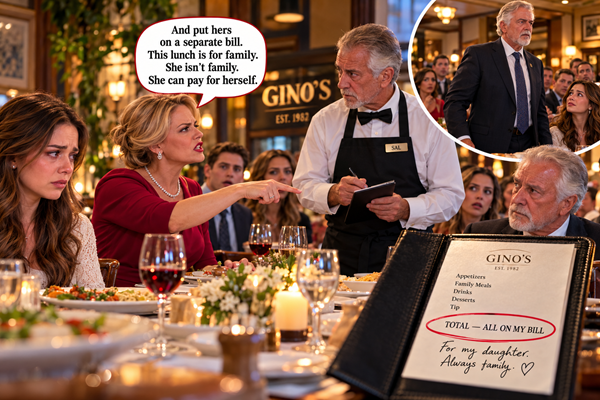
My stepmother looked the waiter straight in the eyes and said, “Put her meal on a separate check. This celebration is for family, and she isn’t family.”
She was talking about me.
At my own father’s retirement lunch.
I had driven three hours to be there. I had spent two months making his retirement gift. And now, sitting at a table surrounded by twelve people, I was being told I didn’t belong.
I was forty-four years old.
But suddenly, I felt nineteen again.
The waiter didn’t reach for his pen.
Instead, he slowly turned toward my father.
And what happened next was something I would remember for the rest of my life.
My dad, Tom Brennan, had delivered mail in Milwaukee for forty-one years.
Forty-one winters of icy sidewalks. Forty-one summers of unbearable heat. Forty-one years of carrying a heavy mailbag through the same neighborhoods, past the same houses, and up the same front steps.
He knew which dogs were friendly and which ones weren’t.
He knew which porch steps were loose.
He knew which elderly neighbors needed someone to bring their packages inside instead of leaving them at the door.
And he knew which houses had gone quiet after someone passed away.
Dad wasn’t a wealthy man.
He never owned a fancy car or took expensive vacations.
But he was the kind of person people remembered.
When he finally retired in October, he didn’t want a big party.
“Just a little lunch,” he told me over the phone. “A few people, some good food, and maybe a slice of that chocolate cake I like.”
He chose Gino’s, a small Italian restaurant on Oakland Avenue.
He’d been eating there every Friday after his shift for years.
The owner knew his name.
The waiters knew his order.
And Dad loved the place because, as he always said, “Nobody there tries to impress anybody.”
My stepmother, Linda, offered to arrange everything.
I should have known that would become a problem.
Linda married Dad nine years earlier, several years after my mother died.
I was nineteen when Mom passed away.
It happened so quickly that I barely remember the weeks afterward.
I remember the hospital hallway.
I remember the flowers.
I remember Dad sitting at the kitchen table long after midnight, staring at an untouched cup of coffee.
And I remember realizing that if I didn’t get up and do something, neither of us was going to survive those first terrible months very well.
Linda never understood that part of our history.
Or perhaps she simply didn’t want to.
From the beginning, she treated me like an inconvenient reminder of Dad’s first marriage.
Whenever we were around her friends, she introduced me as “Tom’s daughter.”
Never Kate.
Never “our daughter.”
Just Tom’s daughter.
As though I were an old piece of furniture that had come with the house.
I tried not to let it bother me.
I was an adult.
I lived in Chicago.
I had my own job, my own home, and my own life.
I didn’t need Linda’s approval.
At least, that’s what I kept telling myself.
But every Christmas dinner, every birthday, and every family gathering reminded me that she had drawn a line.
Her children were family.
I was a visitor.
Still, when Dad called about his retirement lunch, I knew I would be there.
Nothing could have kept me away.
For two months, I’d been working on a gift.
I found an old map of Milwaukee and carefully traced the route Dad had walked for more than four decades.
Every street was marked in blue.
I added little notes beside certain places.
The corner where he once slipped on ice and broke his wrist.
The house where a woman had given him homemade cookies every Christmas for twenty years.
The street where he had found a lost little boy and stayed with him until his mother arrived.
At the bottom, I wrote:
“Forty-one years. Thousands of miles. One incredible dad.”
I had it professionally framed.
The morning of the lunch, I wrapped it in brown paper, placed it carefully in the back seat, and drove from Chicago to Milwaukee.
I arrived early.
Dad was already sitting at the restaurant, wearing the navy-blue sweater I’d bought him the previous Christmas.
When he saw me, his entire face lit up.
“There’s my girl!”
He stood, hugged me tightly, and kissed the top of my head.
For a moment, I was a little girl again, waiting for him to come home from his route.
“I brought you something,” I said.
He laughed.
“You drove all this way. That’s enough of a present.”
But I handed him the package anyway.
He carefully tore away the paper.
Then he stopped smiling.
Not because he disliked it.
Because he recognized every street.
His fingers moved slowly over the blue lines beneath the glass.
He pointed to one corner.
“That’s where Mrs. Henderson used to live.”
Then another.
“Old Mr. Cooper had the meanest German shepherd in Milwaukee.”
He chuckled.
But when he reached the words at the bottom, his eyes filled with tears.
He looked at me.
“Kate, sweetheart…”
He couldn’t finish.
He simply pulled me into another hug.
I could feel him crying against my shoulder.
That moment alone made the entire trip worthwhile.
Then Linda leaned over.
“Oh, that’s nice,” she said.
She tilted her head at the frame.
“Where exactly are we supposed to hang something that big?”
Dad didn’t answer.
He was still looking at the map.
I pretended not to hear her.
Soon the rest of the guests arrived.
There were twelve of us altogether.
Linda’s two sons and their wives.
Her sister.
Several of Dad’s former coworkers.
And me.
I sat near the end of the table.
Linda had placed her sons closest to Dad, even though one of them had only known him for nine years and the other rarely visited.
I didn’t complain.
I was there to celebrate my father.
Not to argue over a chair.
For the first twenty minutes, everything went reasonably well.
Dad told stories about his route.
His old coworker Earl joked about the winter their mail truck got stuck in a snowbank.
Everyone laughed.
Dad looked happy.
And I remember thinking that maybe, just maybe, we could get through one family gathering without Linda making me feel unwelcome.
Then the waiter arrived.
His name was Sal.
He was an older man with silver hair, a neatly pressed white shirt, and an apron tied around his waist.
Dad greeted him like an old friend.
“Sal! You still haven’t retired?”
Sal grinned.
“Somebody has to keep this place running, Tom.”
Everyone laughed.
Sal congratulated Dad and began taking orders.
Linda immediately took over.
She ordered appetizers for the table.
She decided which wine everyone should have.
She interrupted Dad twice when he tried to ask about the specials.
Then Sal reached my end of the table.
“I’ll have the chicken parmesan, please,” I said.
He nodded.
“Excellent choice.”
Before he could write it down, Linda raised her hand.
“Oh, Sal. One more thing.”
He looked up.
“Yes, ma’am?”
Linda pointed directly at me.
“Make sure hers goes on a separate bill.”
Sal paused.
“I’m sorry?”
Linda smiled.
It wasn’t a confused smile.
It wasn’t an embarrassed smile.
It was the kind of smile someone wears when they know exactly what they’re doing.
“This lunch is for family,” she announced, loudly enough for everyone to hear.
Then she looked straight at me.
“And she isn’t family. She can pay for herself.”
I felt the air leave my lungs.
For a second, I genuinely wondered if I’d misunderstood.
Maybe she was joking.
Maybe there was some explanation.
But Linda simply picked up her water glass and took a sip.
As though she’d asked for extra napkins.
Nobody spoke.
One of Linda’s sons stared at his phone.
His wife looked down at her hands.
Linda’s sister suddenly became interested in the menu.
Across the table, Earl slowly lowered his fork.
The tiny sound it made against his plate seemed impossibly loud.
I could feel my face burning.
My hands went cold.
I wanted to disappear.
It was ridiculous.
I was a grown woman.
I could afford my own lunch.
I had never expected Dad to pay for me.
But this wasn’t about money.
It was about being humiliated in front of the people who had gathered to celebrate my father.
It was about hearing, once again, that I didn’t belong.
I swallowed hard.
“It’s okay,” I said quietly. “I’ll pay for mine.”
I reached for my purse.
But Sal didn’t move.
His pen remained above his notepad.
Then, very slowly, he looked toward the head of the table.
“Mr. Brennan?”
Dad was sitting perfectly still.
The framed map rested against his knees.
His hands were folded over the wooden frame.
He wasn’t looking at Linda.
He was looking at me.
I’d seen my father angry before.
When I was sixteen and came home two hours past curfew.
When a neighbor accused him of losing a package he’d personally delivered.
When someone spoke disrespectfully about my mother.
But I’d never seen his face look quite like that.
He seemed almost frighteningly calm.
Sal cleared his throat.
“How would you like me to handle the bill, sir?”
Dad took a breath.
Then he carefully placed the framed map against the empty chair beside him.
And stood up.
Slowly.
His knees weren’t what they used to be after forty-one years of walking.
But he stood straight.
“Sal,” he said, “there will be one check.”
Linda gave a short laugh.
“Tom, don’t be silly—”
Dad continued.
“Everything goes on my bill.”
He paused.
“Every appetizer. Every drink. Every meal.”
Linda shifted in her seat.
“Tom, sit down. You’re making a scene.”
Dad didn’t even look at her.
“And Sal?”
“Yes, sir?”
“Please bring my daughter’s dinner out first.”
Sal’s expression softened.
“Of course, Mr. Brennan.”
He turned and walked toward the kitchen.
The table remained silent.
I expected Dad to sit back down.
He didn’t.
Instead, he looked around at everyone.
“When Kate’s mother died,” he began, “I wasn’t much of a father.”
My heart dropped.
“Dad…”
He gently raised one hand.
“Let me finish, sweetheart.”
His voice was steady, but I could see the emotion in his eyes.
“I’d been delivering mail for years. I thought I knew what hard work was.”
He shook his head.
“But losing my wife nearly destroyed me.”
Nobody moved.
“For weeks, I couldn’t sleep. I couldn’t eat. I couldn’t even get dressed some mornings.”
He looked down at the table.
“I missed work for the first time in fifteen years.”
Then he looked at me.
“And my daughter was nineteen.”
I stared at him.
He had never spoken about those months in front of other people.
Not like this.
“She should’ve been thinking about college classes, friends, and what she wanted to do with her life.”
His voice grew rough.
“Instead, she was worrying about whether her father had eaten breakfast.”
I pressed my lips together.
“She took a semester off school because I couldn’t manage on my own.”
He looked at Earl.
“You remember that winter?”
Earl nodded slowly.
“I remember.”
Dad continued.
“For three months, Kate drove me to work every morning.”
“Sometimes she waited outside until she knew I’d gone inside.”
“She cooked dinner when I couldn’t get off the couch.”
“She cleaned the house.”
“She worked shifts at a restaurant and used her tips to help pay the electric bill.”
I felt tears sliding down my cheeks.
I had never told Linda those things.
I didn’t even know Dad remembered all of them.
Dad placed a hand against his chest.
“One night, I told Kate I didn’t know how to live without her mother.”
He stopped.
His eyes filled.
“And my little girl sat beside me until sunrise, holding my hand.”
I covered my mouth.
Dad looked around the table.
“She was nineteen years old, and she held our family together when I couldn’t.”
Then he turned toward Linda.
“So I’m going to make something very clear.”
Linda’s expression changed.
“Tom, this really isn’t necessary—”
“Yes,” he said quietly.
“It is.”
He pointed toward me.
“That woman is my daughter.”
His voice cracked.
“She is my family.”
He looked at everyone else.
“And nobody at this table gets to decide otherwise.”
For several seconds, there was complete silence.
Then Earl began clapping.
Slowly.
One clap.
Then another.
One of Dad’s other coworkers joined him.
Then the third.
Near the kitchen doorway, Sal stopped walking and began clapping too.
I lowered my head.
I was crying too hard to look at anyone.
Linda’s face had turned bright red.
“I didn’t mean it like that,” she muttered.
Dad looked directly at her.
“Yes, Linda. You did.”
Her mouth opened.
He continued before she could speak.
“You’ve been making Kate feel like a stranger for nine years.”
“That’s not fair!”
“Neither was what you just said.”
Linda glanced around the table, clearly hoping someone would defend her.
Nobody did.
Dad took a slow breath.
“I kept quiet because I thought keeping the peace was the right thing.”
He shook his head.
“But I see now that all I was doing was letting my daughter get hurt.”
Linda whispered, “You’re embarrassing me.”
Dad’s expression didn’t change.
“Imagine how Kate has felt.”
Then he said something that made Earl let out a surprised laugh.
“I’ve spent forty-one years working, Linda. I’m retired now. I’ve finally got time to deal with things I should’ve dealt with years ago.”
Linda said nothing.
Dad sat down.
He reached across the table and squeezed my hand.
“I’m sorry, sweetheart.”
I could barely speak.
“Dad, you don’t have to—”
“Yes,” he said.
“I do.”
A few minutes later, Sal returned carrying a plate of chicken parmesan.
He passed several empty places and stopped beside me.
“Here you go, Kate.”
I looked up.
He smiled.
Then he leaned closer and spoke softly enough that only I could hear.
“Your dad talks about you every Friday.”
I blinked.
“What?”
“Every Friday,” Sal repeated.
“He tells us about your job in Chicago. He shows us pictures. He tells everyone how proud he is of you.”
My throat tightened.
Sal patted my shoulder.
“He talks about you like you’re the best thing that ever happened to him.”
I had to reach for my napkin.
I thought about all those Fridays.
All those years when Dad had sat at this restaurant after finishing his route.
I had imagined him talking about work, sports, and the weather.
I hadn’t known he was talking about me.
The rest of lunch was quieter.
Much quieter.
Linda barely touched her food.
Her sons spoke to one another in low voices.
Earl kept telling stories about Dad’s years at the post office, clearly trying to bring the celebration back to life.
And slowly, Dad began smiling again.
When dessert arrived, Sal brought out a slice of chocolate cake with a little candle.
Everyone sang.
Dad laughed when the candle refused to stay lit.
For a moment, it felt like the afternoon he’d wanted.
When the check came, Dad paid for everything.
Every meal.
Every drink.
Even Linda’s extra glass of wine.
Then he left Sal such a generous tip that Sal hurried after him.
“Tom, this is too much.”
Dad smiled.
“You’ve been taking care of me every Friday for years.”
He closed Sal’s hand around the money.
“Let me return the favor.”
Outside, the October air was cool.
The parking lot was covered in fallen leaves.
Linda walked straight to the car.
She didn’t say goodbye to me.
She didn’t even look in my direction.
Dad watched her for a moment.
Then he turned toward me.
“Come on. I’ll walk you to your car.”
We moved slowly across the parking lot.
He carried the framed map under one arm.
For a while, neither of us spoke.
Then he stopped beside my car.
“Kate?”
“Yeah, Dad?”
He looked at the ground.
“I owe you an apology.”
I shook my head.
“You already apologized.”
“Not for today.”
He looked up.
“For all the other times.”
My chest tightened.
“I knew Linda could be difficult,” he said. “I told myself you were grown up and could handle it.”
He swallowed.
“But you shouldn’t have had to.”
I didn’t know what to say.
Dad continued.
“I thought avoiding arguments would keep our family together.”
He gave a sad little smile.
“But keeping quiet didn’t make things peaceful. It just meant you were the one paying for it.”
I felt tears returning.
“Dad…”
“I should’ve spoken up years ago.”
I reached for his hand.
“You spoke up today.”
He nodded.
Then he pulled me into a hug.
The kind of hug he used to give me when I was little and had scraped my knees.
We stood there for a long time.
When he finally stepped back, he lifted the framed map.
“You know where this is going?”
I smiled.
“Where?”
“Living room.”
I laughed.
“Dad, Linda already said—”
“Right above the television.”
He grinned.
“Biggest wall in the house.”
I laughed through my tears.
“She might not like that.”
Dad shrugged.
“Then she can look somewhere else.”
Before I left, he made me promise to call when I got home.
I did.
And for the first time in years, our conversation didn’t feel rushed.
We talked for almost an hour.
About Mom.
About his retirement.
About places he wanted to visit.
About how strange it felt to wake up without an alarm.
And before hanging up, he said something that stayed with me.
“Kate, I hope you know you never have to earn your place in my life.”
I closed my eyes.
“I know, Dad.”
But the truth was, I hadn’t always known.
Not until that afternoon.
A week later, my phone rang.
It was Dad.
He sounded unusually cheerful.
“Guess what?”
“What?”
“The map’s up.”
I smiled immediately.
“Really?”
“Right where I said it would go.”
“Above the TV?”
“Above the TV.”
I laughed.
“Does it look good?”
“Best thing in the whole room.”
Then he chuckled.
“Linda asked me who made it.”
I went quiet.
I could picture her standing there, staring at the frame she’d dismissed at lunch.
“What did you tell her?”
Dad didn’t hesitate.
“I told her my daughter made it.”
I smiled.
Then he added something that made my eyes fill all over again.
“And I told her that every street on that map reminds me of the years I spent delivering mail. But the person who made it reminds me why I kept coming home.”
I couldn’t speak.
Dad laughed softly.
“Love you, sweetheart.”
“Love you too, Dad.”
After we hung up, I sat there holding my phone.
For nine years, Linda had tried to make me feel like an outsider.
One uncomfortable lunch had brought all those feelings rushing back.
But my father had finally said the words I’d needed to hear.
Not behind closed doors.
Not in a private phone call.
In front of everyone.
And I realized something that afternoon.
Family isn’t determined by who sits closest to you at the table, who shares your last name, or who gets included on the dinner bill.
Family is the person who shows up when your world falls apart.
The person who stays when things become difficult.
The person who remembers what you sacrificed, even when you never expected them to.
And sometimes, family is a seventy-year-old retired mailman who stands up on aching knees and reminds an entire restaurant that his daughter will never be a stranger in his life.
Linda wanted the waiter to give me a separate bill because she said I wasn’t family.
My father made sure everyone knew I was.
And after all those years, that meant more than any gift, any apology, or any celebration ever could. ❤️