 By Admin
 My son charged me $900 a month to live in the smallest guest room in his house.
His mother-in-law lived downstairs for free.
Her suite was nearly twice the size of mine.
She had a private bathroom, a walk-in closet, French doors opening onto the patio, and a garage space because she hated getting into a hot car.
I had a small bedroom upstairs.
I parked on the street.
I bought most of the groceries, cooked several nights a week, walked their elderly golden retriever, and waited around for contractors whenever my son and daughter-in-law were working.
I paid the $900 every month for six months.
Then, one Sunday evening, my son Tyler placed a new sheet of paper beside my dinner plate.
“Starting next month,” he said, “it’ll be twelve hundred.”
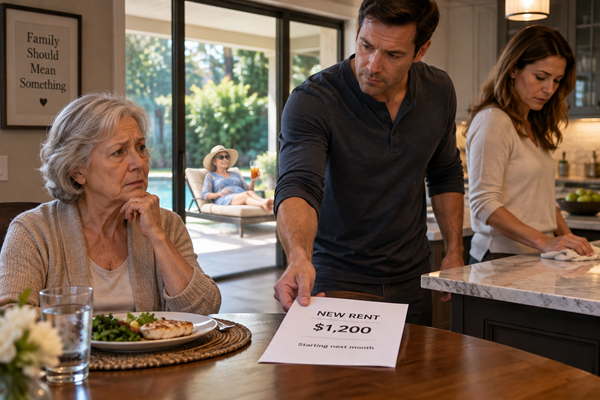
I stared at him.
“Twelve hundred dollars?”
He kept his eyes on the paper.
“Expenses have gone up.”
Across the kitchen island, my daughter-in-law Jessica suddenly became fascinated by a tiny spot on the counter.
I looked through the glass doors toward the backyard.
Her mother, Barbara, was sitting beside the pool with a glass of iced tea.
I turned back to my son.
“How much is Barbara paying?”
Jessica straightened.
“My mother is family.”
For several seconds, nobody spoke.
I looked at Tyler.
“And what exactly am I?”
He sighed.
“Mom, don’t make this dramatic.”
“I asked you a question.”
“This is our house. We decide how things work here.”
“Then answer me. Why am I paying twelve hundred dollars when Barbara pays nothing?”
Jessica folded her arms.
“My mother’s financial situation is different.”
“She sold her house last year,” I said. “That money is invested.”
“So?”
Tyler pushed the paper toward me.
“We’re not discussing Barbara.”
“We are now.”
His jaw tightened.
“Mom, if you don’t like my rules, find somewhere else to live.”
I looked at him for several seconds.
Then I picked up the paper, folded it once, and placed it beside my plate.
“All right.”
Tyler sighed, apparently relieved that the argument was over.
He had no idea I had just taken him seriously.
My name is Eleanor Whitmore.
I was sixty-eight years old when this happened.
For forty-four years, I had been married to a man named William, who believed almost every financial problem could be made less frightening by sitting down at a table with coffee and a calculator.
We weren’t wealthy.
Neither of us ever pretended to be.
We were simply careful.
William worked for a regional utility company for most of his career. I spent twenty-seven years managing the front office of an orthopedic practice before retiring.
We bought ordinary cars and drove them until repairs became unreasonable. We took vacations, but nothing extravagant. We ate out on Friday nights, kept emergency savings, contributed to retirement accounts, and paid extra toward the mortgage whenever we could.
Then William died suddenly from a stroke.
I was sixty-six.
People describe grief as sadness.
For me, sadness was only part of it.
Grief was finding one of his coffee cups in the dishwasher.
It was reaching across the bed at two in the morning and touching a cold pillow.
It was standing in the grocery store in front of a package of six hamburger buns and realizing everything seemed to be packaged for people who expected someone else to be sitting at the table.
The condominium we’d lived in for eighteen years became unbearable.
It wasn’t too large.
It wasn’t too expensive.
It simply contained William everywhere.
His reading glasses were still in the drawer beside his chair.
His old navy windbreaker hung on the hook by the garage.
Three months after the funeral, I finally donated most of his clothes.
I kept the windbreaker.
For nearly a year, I told myself I was adjusting.
Then Tyler started calling more often.
“You shouldn’t be alone so much, Mom.”
“I’m fine.”
“You say that every time.”
“Because I am.”
“You know what I mean.”
Tyler lived about forty minutes away with Jessica in a large two-story suburban house they’d bought six years earlier.
They had no children.
Their home had an open kitchen, a two-story entryway, a pool they rarely used, and more square footage than two people really needed.
Tyler owned a landscaping business.
Jessica worked from home selling medical supplies.
One Sunday over lunch, Tyler said, “Why don’t you stay with us for a while?”
I shook my head.
“I don’t want to intrude.”
“You wouldn’t.”
Jessica smiled.
“We have two guest rooms upstairs, Eleanor. They just sit empty.”
“I still have my place.”
“You don’t have to sell it,” Tyler said. “Just come stay for a few weeks.”
I resisted.
Then, the following week, I spent three entire days without having a real conversation with another person.
I heard my own voice answering a television commercial.
That frightened me more than I wanted to admit.
So I packed a suitcase.
Three weeks became three months.
And strangely enough, I felt better.
There was noise again.
A television playing in another room.
Cabinet doors opening.
Tyler coming home and dropping his keys on the kitchen island.
Jessica talking on conference calls.
And Cooper, their elderly golden retriever, scratching at my bedroom door every morning because he had decided I was the person most likely to feed him before sunrise.
I began making dinner.
At first, occasionally.
Then several nights a week.
I walked Cooper because Tyler’s knees hurt after long days on landscaping jobs.
I picked up groceries.
I waited for plumbers, appliance deliveries, pool technicians, and contractors.
Nobody asked me to do those things.
I did them because being useful felt good.
Around the same time, Tyler’s business hit a rough patch.
He lost two commercial maintenance contracts within a month.
Then Jessica’s kitchen renovation went over budget.
One evening I found Tyler sitting alone at the kitchen table with invoices spread in front of him.
It reminded me so much of his father that I had to look away.
“How bad?” I asked.
He rubbed his forehead.
“Not catastrophic.”
“That usually means bad.”
He smiled.
“We’ll get through it.”
I sat across from him.
“Do you need help?”
“No.”
“Tyler.”
“I said no, Mom.”
I knew my son well enough to recognize pride when it was standing in the way.
Two days later, I transferred him $20,000.
When I told him, he stared at me.
“You shouldn’t have done that.”
“I wanted to.”
“Mom…”
“You can pay me back someday if it bothers you.”
His eyes filled with tears.
He came around the table and hugged me.
“I swear I’ll never forget this.”
I believed him.
About six months after I moved in, I decided to sell my condominium.
Not because I needed the money.
Because I knew I wasn’t going back.
The day after closing, I sat in my car outside the title company and cried so hard I had to wait nearly twenty minutes before I could drive.
That condo had been the last home William and I owned together.
Selling it felt like admitting something I had spent a year trying not to admit.
There would never be another Tuesday morning with him drinking coffee at that kitchen counter.
No amount of keeping the property could preserve that life.
Tyler knew the sale had closed.
He asked what I planned to do with the money.
“Invest most of it.”
“How much did you clear?”
“Enough.”
He laughed.
“You sound like Dad.”
“That’s intentional.”
He asked again a few weeks later.
I gave him the same answer.
The truth was that William and I had done better financially than Tyler realized.
Between the condo sale, life insurance, retirement savings, and investments we’d accumulated over four decades, I could live comfortably.
Not lavishly.
Comfortably.
I could buy another modest home without a mortgage if I wanted to.
I never told Tyler exactly how much I had.
At first, there was no reason to.
Later, there was a reason not to.
He began asking questions.
Had I changed the beneficiary on my retirement account?
How much was I spending each month?
Had I considered letting him help manage my investments?
Was the money from the condo sale sitting in cash?
Each question could be explained by itself.
Together, they made me cautious.
William had always been very clear about money and adult children.
“Help if you want,” he once told me. “But don’t confuse helping them with handing them control.”
I remembered those words.
Then Barbara moved in.
Barbara was Jessica’s mother.
She was sixty-five, divorced, energetic, outspoken, and perfectly capable of taking care of herself.
She had recently sold a house in another part of the state and said she wanted to be closer to Jessica.
I assumed she’d stay for a few weeks while looking for another place.
Then a moving truck arrived.
Nobody had mentioned that part.
I stood near the staircase watching two men carry a king-size mattress downstairs.
Jessica walked past carrying a box labeled BATHROOM.
“Your mother is moving in?”
She looked surprised.
“Tyler didn’t tell you?”
“No.”
“Oh.”
That was the entire explanation.
The downstairs mother-in-law suite had originally been designed for a future live-in parent or long-term guest.
It had a large bedroom, private bathroom, walk-in closet, sitting area, and French doors opening toward the pool.
I had never minded living upstairs.
Until I watched Barbara move into a space almost twice the size of mine.
That evening, Tyler knocked on my door.
“Everything okay?”
“Fine.”
“You seem quiet.”
“I didn’t know Barbara was moving in.”
“Jess wanted her closer.”
“I understand.”
He hesitated.
“Is that a problem?”
“No.”
And at the time, it wasn’t.
What bothered me was what happened afterward.
The house had two garage spaces.
One belonged to Tyler.
Jessica used the other.
I parked in the driveway.
When Barbara moved in, Jessica announced that her mother needed the driveway spot closest to the garage because carrying groceries was difficult.
Two weeks later, Barbara wanted Jessica’s garage space because the summer heat made her car unbearable.
Jessica began parking in the driveway.
I began parking on the street.
Nobody asked me.
One morning, after a storm, I found my car covered in wet leaves.
Tyler walked past while I was cleaning the windshield.
“Why didn’t you park in the driveway?”
“There wasn’t room.”
He glanced toward Barbara’s car inside the garage.
“Oh. Right.”
Then he went to work.
When Barbara complained that the mattress in her suite was too firm, Jessica ordered a new one.
When Barbara said the pool was too cold, Tyler turned the heater up.
When she said she preferred wild-caught salmon, Jessica added it to the grocery list.
The first time I saw it, I laughed.
“What?” Jessica asked.
“Nothing.”
“What’s funny?”
“I didn’t realize we were taking seafood requests.”
“My mother has always been particular.”
“Apparently.”
I bought the salmon.
Then I cooked it.
That became another pattern.
Barbara wasn’t cruel to me.
That almost made everything harder to explain.
She simply behaved as if the house had been arranged around her comfort, and Tyler and Jessica behaved as if that were perfectly natural.
I would make dinner while Barbara sat beside the pool reading.
I would walk Cooper while she went to yoga.
I would spend an afternoon waiting for a cabinet installer because Jessica had a meeting.
Barbara’s schedule remained untouched.
I began noticing other things.
If I left a sweater on a chair in the family room, Jessica moved it upstairs.
“Trying to keep the shared spaces uncluttered,” she’d say.
Barbara could leave magazines, reading glasses, sandals, and a half-finished cup of tea on the patio table overnight.
Nobody said anything.
If I had a friend stop by for coffee, Jessica wanted advance notice.
“My work calls are confidential.”
If Barbara invited women from her book club, they could sit beside the pool for three hours.
Again, nobody said anything.
I told myself not to become petty.
Grief does strange things to your sense of belonging.
You become grateful for any place that feels somewhat like home, even after it stops treating you like family.
Then came the rent.
Tyler approached me one Tuesday evening with a piece of notebook paper in his hand.
“Can we talk?”
“Of course.”
We sat at the kitchen island.
He slid the paper toward me.
At the top, he’d written:
HOUSEHOLD CONTRIBUTION: $900 MONTHLY
I thought it was a joke.
Then I saw his face.
“What is this?”
“Everyone needs to pitch in.”
“I already do.”
“I mean financially.”
I stared at him.
“I buy groceries.”
“We appreciate that.”
“I paid for the freezer in the garage when yours stopped working.”
“I know.”
“I cook. I take care of Cooper. I wait here for contractors so neither of you has to miss work.”
“That’s different.”
“How?”
He shifted in his chair.
“This is still our house, Mom. Taxes, utilities, maintenance, pool service. Everything costs money.”
I looked at the paper again.
“Nine hundred dollars.”
“It’s much less than an apartment.”
There it was.
The first time my son described my room as though I were renting it from a stranger.
I looked through the window.
Barbara was lying on a lounge chair beside the pool.
“How much does Barbara pay?”
Tyler’s jaw tightened.
“This isn’t about her.”
“It becomes about her when you say everyone needs to pitch in.”
Jessica came into the kitchen carrying her laptop.
“What’s going on?”
Tyler said, “Nothing.”
I looked at her.
“Tyler wants me to pay nine hundred dollars a month.”
Jessica nodded.
“Yes.”
“You knew?”
“We discussed it.”
“Does Barbara pay nine hundred too?”
Jessica stiffened immediately.
“My mother’s situation is completely different.”
“How?”
“Her money is tied up.”
“In what?”
“Investments.”
I almost asked whether investments prevented someone from writing checks.
Instead, I looked at Tyler.
“Do you really think this is fair?”
He avoided my eyes.
“It’s not about fair.”
Those four words should have told me everything.
But grief had made me afraid of losing one more person.
I’d already buried my husband.
I couldn’t stand the thought of a serious break with my only son.
So I paid.
The first month, I wrote Tyler a check.
He deposited it the next morning.
He never mentioned the $20,000 I’d given him.
Neither did I.
After that, the atmosphere in the house changed.
Not immediately.
Slowly.
At first, I thought paying rent might make me feel more secure.
If I was contributing financially, perhaps I’d feel less like a guest.
The opposite happened.
Jessica became more territorial.
One Saturday morning, I was reading in the family room when she walked in carrying a laundry basket.
“I was thinking we might start keeping this room more private in the evenings.”
I lowered my book.
“What do you mean?”
“Tyler and I don’t get much time alone.”
“I go upstairs by nine most nights.”
“I know. I’m just saying after dinner maybe this could be our private sanctuary.”
Private sanctuary.
I looked around the room.
Two sofas.
A television.
Cooper asleep under the coffee table.
“Of course.”
From then on, I spent most evenings in my bedroom.
A room I paid $900 a month to occupy.
A month later, my friend Marjorie stopped by.
We’d worked together at the orthopedic practice for seventeen years.
She brought pastries and a small potted plant.
We sat at the kitchen table for forty-five minutes.
That evening, Jessica said, “Could you let me know a few days ahead next time you’re having company?”
“Company?”
“Your friend.”
“Marjorie?”
“Yes.”
“She stopped for coffee.”
“I know, but I had client calls.”
“She wasn’t anywhere near your office.”
“It’s just respectful.”
I almost asked whether Barbara’s book club had to submit written notice.
I didn’t.
I had become very good at swallowing sentences.
Then came the boxes.
I returned from lunch with Marjorie and went upstairs to change.
When I opened my bedroom door, six cardboard boxes were stacked beside my dresser.
Three nearly reached the bottom of the window.
I stood there for a full minute.
I opened one.
Christmas decorations.
The second contained photo albums.
The third held winter clothes.
I went downstairs.
Jessica was standing at the sink.
“Did you put boxes in my room?”
She turned.
“My mom needed storage.”
“Barbara?”
“Yes.”
“She has a walk-in closet.”
“It’s full.”
“She has a storage closet beside her bathroom.”
“Also full.”
“So you put her things in my bedroom?”
Jessica looked annoyed.
“They’re just boxes.”
“They’re blocking my window.”
“We can move them over a little.”
“No.”
Her expression changed.
“What do you mean, no?”
“I mean they don’t belong in my room.”
“Eleanor, the house has limited storage.”
“Then your mother should decide what she needs.”
Jessica folded her arms.
“This is my house.”
For once, I didn’t soften my answer.
“And this is the room your husband charges me nine hundred dollars a month to occupy.”
She stared at me.
“I don’t appreciate that tone.”
“I don’t appreciate coming home to find someone else’s belongings stacked in the room I’m paying for.”
“You make everything sound transactional.”
I almost laughed.
“You started charging rent.”
She picked up her mug and walked away.
I carried every box downstairs myself.
I placed them neatly outside Barbara’s suite.
Barbara came out while I was moving the last one.
“Oh.”
“These are yours.”
“I know.”
“Jessica put them in my room.”
“She said there was space.”
“There wasn’t.”
Barbara looked embarrassed.
To her credit, she said, “I’m sorry. I didn’t know she was putting them upstairs.”
That moment mattered.
Because it confirmed something I’d been slowly realizing.
Barbara wasn’t the real problem.
She accepted the advantages offered to her, certainly.
She enjoyed being taken care of.
But she hadn’t asked Tyler to charge me rent.
She hadn’t told Jessica to police my friends.
She hadn’t put those boxes in my room.
My conflict was with my son and daughter-in-law.
That night, I sat on my bed and looked around.
Small dresser.
Twin windows.
Old armchair.
My television.
A framed photograph of William and me on our thirtieth anniversary.
I’d spent months telling myself I lived with family.
Suddenly the room looked like what Tyler had made it.
A rental.
And not a particularly good one.
I picked up my phone and called Diane, my financial advisor.
She’d worked with William and me for years.
“I think I’m ready to buy another home,” I told her.
There was a pause.
Then she said, “I wondered when you’d say that.”
I laughed.
“You did?”
“You’ve sounded restless lately.”
“What can I comfortably spend without touching the long-term part of the portfolio?”
She gave me a range.
It was higher than I’d expected.
“I don’t need anything large,” I said.
“Then don’t buy large.”
“I want something easy.”
“Then buy easy.”
That sounded exactly like William.
The next morning, I called Marjorie.
“Are you busy tomorrow?”
“Why?”
“I want to look at houses.”
There was silence.
Then she practically shouted, “Finally!”
I laughed.
“Was everyone waiting for me?”
“Only everyone with eyes.”
We saw five houses that first weekend.
Three were immediately wrong.
One had too many stairs.
Another backed onto a busy road.
A third had an enormous yard that made my knees ache just looking at it.
The fourth was attractive but dark inside.
Then we saw a small single-story house in a fifty-five-plus community about twenty-five minutes from Tyler.
Two bedrooms.
A bright kitchen.
A screened patio.
A little office with built-in shelves.
A yard maintained by the homeowners association.
The primary bedroom had two windows facing east.
When I walked inside, something happened that I hadn’t expected.
I imagined waking up there.
Not with William.
I was finally beginning to understand that imagining a future without him wasn’t the same as leaving him behind.
I walked onto the screened patio.
A maple tree stood beyond the fence.
A woman two houses down was watering flowers.
Somewhere nearby, someone was playing old Motown music.
Marjorie stood beside me.
“Well?”
“I like it.”
“You’ve said that about exactly zero of the other houses.”
“I know.”
“Call the agent.”
I did.
Two days later, I made an offer.
It was accepted.
I didn’t tell Tyler.
Not because I wanted a dramatic reveal.
I was afraid he’d talk me out of it.
Not because the purchase was irresponsible.
Because I’d become accustomed to doubting myself whenever Tyler disagreed with me.
Diane reviewed the numbers.
The inspection came back clean except for minor issues.
I paid cash from the condo proceeds and a short-term account William and I had always kept for major purchases.
I still had substantial retirement savings afterward.
I signed the closing papers on a Thursday morning.
For the first time in nearly two years, I had a home of my own.
That afternoon, I sat alone in the empty living room.
I should have felt triumphant.
Instead, I cried.
I wished William could have seen the place.
I imagined him inspecting the water heater, testing every window latch, and complaining that the previous owner had used the wrong anchors for the garage shelves.
Then I heard his voice in my head.
Good bones, Ellie.
He always said that about houses.
I wiped my face.
“All right, Bill,” I whispered. “Good bones.”
I spent the next month getting ready quietly.
A sofa.
A dining table.
A new mattress.
Curtains.
A modest patio set.
Marjorie helped me choose lamps.
I moved small items while Tyler and Jessica were working.
Nobody noticed.
That alone told me something.
For people who claimed I was part of the household, they paid surprisingly little attention to my actual life.
Then Tyler raised my rent.
It happened on a Sunday.
Jessica had made pasta.
Barbara was outside after dinner.
Tyler slid the new agreement beside my plate.
Twelve hundred dollars.
I asked again why Barbara paid nothing.
Jessica gave me the same answer.
“My mother is family.”
I asked Tyler what that made me.
He gave me the sentence that finally freed me.
“If you don’t like my rules, find somewhere else to live.”
“All right,” I said.
He thought I’d surrendered.
The next morning, I called a moving company.
They could come Friday.
I spent Monday through Thursday packing.
I didn’t hide what I was doing.
I simply started with things nobody noticed.
Books.
Winter clothes.
Bathroom items.
Photographs.
On Thursday afternoon, Jessica finally stood in my doorway.
“What are you doing?”
I folded a sweater into a box.
“Packing.”
“For what?”
“I’m moving.”
She laughed once.
Then she realized I wasn’t joking.
“Where?”
“My house.”
“What house?”
“The one I bought.”
Her mouth fell open.
“You bought a house?”
“Yes.”
“When?”
“I closed three weeks ago.”
She stared at me.
“You didn’t tell us.”
“No.”
“Why?”
I taped the box closed.
“I wasn’t aware I needed permission.”
“That isn’t what I mean.”
“Then what do you mean?”
“Tyler is going to lose his mind.”
“Why?”
“You bought a house without talking to him.”
“I’m sixty-eight years old.”
“He worries about you.”
I looked around the tiny room.
“Does he?”
Jessica’s face hardened.
“That’s unfair.”
“Maybe.”
She disappeared downstairs.
I heard her calling Tyler before she reached the bottom step.
He arrived home thirty minutes later.
I was carrying folded towels into a box when he walked into my room.
“You bought a house?”
“Yes.”
“Without telling me?”
“Yes.”
“What were you thinking?”
That question irritated me more than I expected.
“I was thinking I needed somewhere to live.”
“You live here.”
“You told me to find somewhere else.”
“Mom, come on. You know I was angry.”
“I didn’t.”
“You took that literally?”
“You handed me a rent increase and told me to leave if I didn’t like it.”
He ran both hands over his face.
“Where is this place?”
I told him the neighborhood.
His eyebrows rose.
“That community isn’t cheap.”
“I can afford it.”
“How?”
I looked at him.
“What do you mean, how?”
“Did you finance it?”
“No.”
“You paid cash?”
“Yes.”
He sat down on the edge of my bed.
For a moment, the anger disappeared from his face.
“How much money do you have?”
There it was.
Not Are you happy?
Not Is the house safe?
Not Do you need help moving?
How much money do you have?
I continued folding towels.
“Enough.”
“Mom.”
“Tyler.”
“I’m your son.”
“I know.”
“Why are you being secretive?”
“I’m private. That’s different.”
“You gave me twenty thousand dollars last year.”
“Yes.”
“I thought that was a big part of what you had from the condo.”
“It wasn’t.”
He stared at me.
“How much did Dad leave you?”
“That isn’t relevant.”
“It is if you’re making major financial decisions.”
“To whom?”
“What?”
“Relevant to whom? Me or you?”
He stood.
“You don’t have to make everything an accusation.”
“And you don’t have to make every dollar I have your business.”
“I’m trying to protect you.”
“From buying a two-bedroom house I can afford?”
“You could have talked to me.”
“I tried talking to you about the arrangement here.”
“That’s different.”
“It always is.”
Jessica appeared in the doorway.
“Tyler, Barbara is asking what’s going on.”
I looked at them.
“I’m moving Friday.”
“Tomorrow?” Jessica asked.
“Yes.”
“That’s ridiculous.”
“The movers arrive at nine.”
Tyler stared at me.
“You arranged movers too?”
“I managed a medical office for twenty-seven years. I’m capable of arranging a moving truck.”
He shook his head.
“This is insane.”
“No. Paying twelve hundred dollars for this room while being treated like an inconvenience would have been insane.”
Jessica crossed her arms.
“Nobody treated you like an inconvenience.”
“You put your mother’s storage boxes in my bedroom.”
“I moved them.”
“I moved them.”
She looked away.
Tyler said, “Can we all calm down?”
“I am calm.”
“Then postpone the movers.”
“No.”
“One week.”
“Why?”
“So we can figure this out.”
“I already figured it out.”
His face changed.
There was fear there now.
Not financial fear.
Something more personal.
“You’re really leaving.”
“Yes.”
“You’re angry.”
“I was angry.”
“And now?”
“Now I’m done arguing.”
He sat beside me again.
“What do you want me to say?”
I thought about that.
Six months earlier, I would have had a list.
Apologize.
Admit the double standard.
Tell Jessica I mattered.
Charge Barbara too.
Give me back my money.
By then, none of those things were enough.
“I don’t need you to say anything.”
“That’s worse.”
“I know.”
He looked down.
“What about the twelve hundred?”
“You won’t have to worry about collecting it.”
He gave a short, humorless laugh.
“Mom.”
“What?”
“This isn’t about the money.”
That almost made me angry again.
“It became about money the day you slid a rental agreement across the kitchen counter.”
“That wasn’t what I meant.”
“Then what did you mean?”
He had no answer.
The movers arrived at nine the next morning.
Marjorie came at eight-thirty with coffee.
Tyler came downstairs wearing work clothes.
“I canceled my morning jobs,” he said.
“You didn’t have to.”
“I’m helping.”
Jessica stood in the kitchen.
She didn’t help.
Barbara did.
That surprised me.
She carried small boxes and wrapped two framed photographs in towels.
At one point, she picked up a picture of William and me from our fortieth anniversary.
“You two look happy.”
“We were.”
She handed it back carefully.
“I’m sorry things turned out like this.”
“So am I.”
Then she said something that surprised me even more.
“For what it’s worth, I told Jessica they should never have charged you rent if they weren’t going to charge me.”
I blinked.
“You did?”
“She told me it was none of my business.”
I laughed.
“That sounds familiar.”
Barbara smiled.
“I offered to pay something when I first moved in.”
“What happened?”
“Jessica said absolutely not.”
I looked toward the kitchen.
That hurt in a new way.
Not because Barbara had done anything wrong.
Because Tyler and Jessica’s choice had been clearer than I’d realized.
They hadn’t forgotten to treat us equally.
They had consciously decided we were different.
By noon, my room was empty.
The little rectangle where my dresser had stood was lighter than the rest of the carpet.
I stood in the doorway.
For almost two years, that room had held my entire private life.
Now it looked like what it had always been.
A guest room.
Tyler carried the final box downstairs.
“You ready?”
“Yes.”
When I opened the front door of my new house later that afternoon, sunlight filled the living room.
My sofa was in place.
The dining table stood beneath a simple pendant light.
Several boxes were stacked against the wall.
Tyler walked through slowly.
“This is nice.”
“I think so.”
He looked into the kitchen.
“You bought all this furniture?”
“Some new. Some used.”
He opened the back door.
“This is really nice.”
“You already said that.”
“I mean it.”
He stood outside looking toward the maple tree.
Then he turned to me.
“Why didn’t you tell me you were this unhappy?”
I leaned against the doorframe.
“I did.”
“Not like this.”
“How many different ways was I supposed to say it?”
He looked down.
“I thought you were complaining.”
“I was.”
“I mean, I thought you were just irritated.”
“I was paying rent for a room I wasn’t allowed to fully use while your mother-in-law lived in a suite for free.”
He winced.
“When you say it that way…”
“How else should I say it?”
He had no answer.
We sat on the patio.
For several minutes, neither of us spoke.
Then Tyler said, “I owe you money.”
I looked at him.
“The twenty thousand?”
“Yes.”
“I told you I didn’t expect it immediately.”
“I know.”
“You needed help.”
“I still should have paid you back before charging you rent.”
That was the first time he said it.
Not because I forced him.
Not because he wanted me to stay.
Because standing in my new house had apparently made something obvious.
“I agree,” I said.
“I can’t do twenty thousand at once.”
“I know.”
“But I can start paying you monthly.”
“All right.”
“I mean it.”
“I know.”
He pulled out his phone.
“What was Diane’s number?”
I laughed.
“What?”
“I want someone to help me set up an automatic transfer.”
“You don’t need Diane for that.”
“I’m trying to prove I’m serious.”
“You can prove it next month.”
He smiled.
Then he sighed.
“Jess is mad.”
“I assumed.”
“She thinks you did this to embarrass us.”
“I bought myself a house to embarrass you?”
“I told her that didn’t make sense.”
“Good.”
“She thinks you could have given us more warning.”
“You gave me four days’ warning before raising my rent.”
He rubbed his face.
“I walked into that one.”
“Yes.”
We sat quietly.
Then he asked the question he should have asked much earlier.
“Are you going to be okay here alone?”
I looked through the screen toward my neighbor watering flowers.
“I think I need to find out.”
He nodded.
“Okay.”
The first month in my new house was strange.
Wonderful and strange.
The silence came back.
But it was different.
The condo had been silent because William was missing from a place where he belonged.
This house was quiet because it was new.
Nothing was missing yet.
I could build something there.
Marjorie came for coffee whenever she wanted.
No advance notice required.
I joined a water aerobics class at the community center, mostly because I hated it enough to know William would have found the whole thing hilarious.
I met a widow named Ruth who lived three streets away.
We started walking in the mornings.
I bought a small grill for the patio.
I adopted a seven-year-old terrier mix named Walter from a rescue group.
He snored louder than William ever had, which I hadn’t believed was possible.
Tyler visited every Sunday for the first month.
Then every other Sunday.
Sometimes Jessica came.
Sometimes she didn’t.
Our relationship was awkward for a while.
I didn’t punish them.
I didn’t constantly remind them of what happened.
But I stopped making myself endlessly available.
When Jessica called and asked whether I could wait at their house for a contractor, I said, “I have plans.”
The plans were lunch with Ruth.
They still counted.
When Tyler asked if I could make my chicken casserole for a family dinner, I said yes.
When he asked if I could pick up all the groceries on the way, I said, “Send me half the cost.”
He paused.
Then said, “Sure.”
That tiny pause told me how much had changed.
Barbara continued living with them.
About two months after I moved, she called me.
Not Jessica.
Barbara.
“Do you have room for lunch on Tuesday?”
I laughed.
“In my entire house?”
“At your table.”
“Yes.”
She came carrying a salad.
We ate on the patio.
Halfway through lunch, she said, “Jessica has started talking about household expenses.”
I nearly choked on my iced tea.
“Oh?”
“She thinks I should contribute.”
I looked at her.
Barbara raised one eyebrow.
“Apparently I am still family, but utilities are expensive.”
I laughed so hard my eyes watered.
Barbara laughed too.
Then she said, “I probably should contribute.”
“That’s between you and them.”
“I know.”
“Please don’t drag me into it.”
“I wouldn’t dream of it.”
We both knew that wasn’t entirely true.
Several months later, Tyler began repaying the $20,000.
Five hundred dollars at a time.
The first transfer appeared in my checking account on the first of the month.
I stared at it for a while.
Then I sent him a message.
Received. Thank you.
He replied:
Should’ve started sooner.
I wrote:
Yes.
A minute later, my phone rang.
“You really couldn’t just say thank you?”
“I did.”
“You added yes.”
“You said you should’ve started sooner.”
“I know.”
“So I agreed.”
He laughed.
“All right, Mom.”
It was the first easy conversation we’d had in a long time.
The rent money was never returned.
I never asked for it.
Some people later told me I should have.
Maybe they were right.
But to me, those months became tuition.
Not for Tyler.
For me.
I paid to learn something I should have understood sooner.
Being needed isn’t the same as being valued.
Being tolerated in someone else’s house isn’t the same as belonging there.
And helping adult children doesn’t require making yourself small enough to fit whatever space they decide to leave for you.
About a year after I moved, Tyler came over alone.
We sat at my dining table with coffee.
Walter slept beneath his chair.
Tyler looked toward the framed photograph of William on the bookshelf.
“Dad would’ve been mad at me.”
I didn’t answer immediately.
“Probably.”
He smiled sadly.
“You could pretend.”
“Your father hated pretending.”
“I know.”
He picked up his coffee.
“He would’ve said something about me forgetting who helped me get started.”
“Probably.”
Tyler looked at me.
“I really did forget.”
I shook my head.
“No.”
“What?”
“You didn’t forget the twenty thousand.”
He looked uncomfortable.
“You forgot what it meant.”
He waited.
“It wasn’t rent. It wasn’t an investment in your business. It wasn’t leverage. I gave it to you because you were my son and you were scared.”
He looked down.
“I know.”
“When you charged me rent while Barbara lived there free, it wasn’t the nine hundred dollars that hurt.”
“I know that now.”
“I didn’t need free housing.”
“I know.”
“I needed to know I was still your mother in that house.”
His eyes filled.
“I’m sorry.”
That time, I believed the apology.
Not because it fixed everything.
Because he finally understood what he was apologizing for.
Months passed.
The repayments continued.
Tyler’s landscaping business recovered slowly.
Jessica’s resentment faded.
Barbara eventually rented a condo nearby because she wanted her own kitchen and to live closer to friends from her book club.
When she told me, I smiled.
“So you’re finding somewhere else to live?”
She looked at me.
Then we both laughed.
“Yes,” she said. “But nobody raised my rent.”
“Yet.”
She laughed.
There was no dramatic confrontation when Barbara left.
No punishment.
No family member begging forgiveness in front of everyone.
Life rarely wraps itself that neatly.
The important change had already happened.
I had my own front door.
My own kitchen.
My own driveway.
If Marjorie came over without notice, nobody asked whether she’d scheduled her visit.
If I wanted to read in the living room until midnight, I did.
If Walter left a toy in the hallway, it stayed there until I decided to move it.
My home wasn’t large.
It wasn’t impressive.
But every room belonged to me.
That mattered more than I expected.
On the second anniversary of William’s death, Tyler came over with flowers.
We made hamburgers on the grill because that had been William’s favorite thing to cook badly.
Tyler burned the first batch.
I told him his father would have been proud.
We sat outside after dark.
At one point, Tyler asked, “Do you ever regret selling the condo?”
“Sometimes.”
“Do you regret moving in with us?”
I thought about that for a long time.
“No.”
He looked surprised.
“Really?”
“I regret staying as long as I did.”
“That sounds more accurate.”
“But moving in helped me survive the worst year of my life.”
He nodded.
“And moving out taught me I could survive the next one.”
We sat quietly after that.
I looked through the screen at the maple tree moving in the evening breeze.
For a long time after William died, I thought starting over meant erasing him.
I was wrong.
There were photographs of him in every room.
His old windbreaker still hung inside my hall closet.
I still used the cast-iron skillet he’d seasoned for thirty years.
I still heard his voice sometimes when I made a financial decision.
But I no longer lived as if my life had ended when his did.
That may have been the greatest thing my son accidentally gave me.
He told me to find somewhere else to live.
So I did.
And by taking him seriously, I finally started taking myself seriously too.
These days, when Tyler comes over, he knocks.
Not because the door is locked.
Because it is my house.