 By Admin
 At exactly six o’clock on Christmas Eve morning, Diane Foster woke to a silence that felt instantly wrong. Her house was never this quiet. For three years, every morning had started with noise — her son Marcus stomping through the hallway hunting for coffee, his wife Brielle talking loudly on the phone before anyone else was awake, toys scattered across the living room by the kids, and Brielle’s parents showing up whenever there was free food, free space, or a chance to stay somewhere without paying.
That morning: nothing. No footsteps, no doors, no arguing. Diane sat up and looked toward the window.
The driveway was empty. Marcus’s truck was gone. So was the rental van Brielle had insisted they needed. At the front door, the pile of suitcases, coats, ski gear, and kids’ bags that had crowded the entryway the night before had vanished too.
For several seconds she just sat there. Today was the start of the family’s Christmas trip — a week at a luxury ski resort, a trip Diane had spent months organizing and paying for. She grabbed her phone and opened the family group chat.
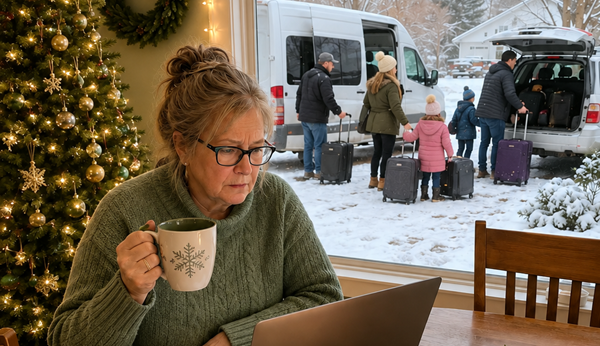
It wasn’t there. She searched again. Nothing. They hadn’t forgotten to wake her. Someone had removed her.
Diane slipped on her robe and went downstairs. The kitchen looked like a storm had passed through — wrappers on the counter, one child’s mitten under a chair, the coffee maker still warm. They’d left recently, and they’d left without her.
She called Marcus. Brielle answered.
Wind roared through the speaker, tires humming on the highway.
“Good morning, Brielle. Where’s Marcus?”
A pause, then an uneasy laugh. “Oh, Diane.”
That hesitation told her everything.
“Where are you?”
“We’re already on the road.”
“To where?”
Another pause. “The resort.”
Diane stared through the window at the empty driveway. “The resort,” she repeated.
“Yeah, it got hectic. The kids were restless, my parents wanted an early start, everyone was rushing. We figured it’d be easier to just go.”
“And when were you planning to tell me?”
“Tell you what?”
“That ten people were leaving on a vacation I paid for, without me.”
Silence. Then a sigh. “Diane, please don’t make this dramatic.”
Diane almost laughed. Dramatic. Her son, daughter-in-law, grandchildren, and in-laws had packed up, loaded two vehicles, driven off before sunrise, and quietly dropped her from the family chat — and somehow she was making it dramatic.
“You’ve been under a lot of stress,” Brielle went on. “Maybe this is good for you — a quiet Christmas at home, watch your shows, relax.”
Diane looked around her own kitchen, where Brielle had spent years complaining the television was too loud. Now she was recommending Diane sit alone and watch it.
“I see,” Diane said.
“So you’re not upset.”
Diane smiled. “Not at all. I hope you all have exactly the Christmas you planned.”
She ended the call, set the phone on the counter, and stood still for almost a minute. Then she walked to her office.
Three years earlier, after her husband died, Diane had let Marcus and Brielle move into the finished lower level of her house — supposed to be six months while they saved for a place of their own. Six months became a year. A year became three. Brielle stopped acting like a guest — rearranging the kitchen, replacing decorations, criticizing the furniture, inviting her own parents over whenever she liked. Marcus never pushed back. “Mom, let’s not make everything a problem,” he’d say. So Diane had learned to stay quiet.

Until now.
She opened her laptop. There it was: the reservation confirmation. Luxury ski resort, seven nights, private suites, holiday package. $12,500.
She remembered something else — a crumpled paper in the kitchen trash the night before. She dug it out and smoothed it on the counter. A printed room list.
Master suite: Marcus and Brielle. Guest suite one: Brielle’s parents. Guest suite two: Brielle’s sister and husband. Bunk room: the kids.
She read it twice. Her name wasn’t missing by accident. There had never been a room for her. She’d paid for a vacation built to exclude her.
A strange calm settled over her. She opened the reservation portal, hovered over Cancel, and whispered, “Enjoy the mountains.” Three clicks later, it was done. The refund notice landed a minute after.
She leaned back, wide awake for the first time that morning. They wanted a Christmas without her — fine. But she wasn’t obligated to keep funding it, either. Before the day was over, Marcus and Brielle would learn that leaving her behind had been costly.
Diane spent the next several hours doing nothing, and enjoyed every minute — no dishes, no arguing kids, no one asking where she kept things she’d owned for decades. She made chamomile tea and sat down with the novel she’d been trying to finish for months.
At 2:47 p.m., her phone rang. Marcus. She let it go. It rang again. And again. By the time she finally answered, she had eleven missed calls.
“Mom, thank God—”
“Did you make it to the resort?” she asked, turning a page.
“Yes, but they won’t give us keys. The manager says the reservation was cancelled.”
Behind him, Brielle shouted, “Tell her to fix it! My parents have been sitting in the car all day!”
Diane took another sip of tea. On the fifteenth call, she answered again to keep talking.
“My card didn’t decline, Marcus,” she said. “I cancelled it myself.”
Silence. “You what?”
“I cancelled it.”
“Why would you do that?”
“Because this morning your wife explained I wasn’t part of the vacation. Was my name on the room list?”
He didn’t answer. That silence told her he’d known.
“You planned a trip without me and expected me to pay for it,” she said.
“Mom, it’s complicated—”
“No. It’s simple.”
“You’re seriously leaving us stranded? There are ten of us.”
“And apparently there was room for all ten of you.”
The phone shifted hands. “Diane, you need to call the resort right now,” Brielle snapped.
“You should probably find somewhere to sleep.”
“You’re unbelievable.”
“And yet I’m still at home.”
“This is childish.”
“Leaving a seventy-year-old asleep in her own house while you drove off on the vacation she paid for — that was childish. Cancelling a reservation that belongs to me is a financial decision.”
“You ruined Christmas.”
“No. I stopped financing yours.”
Diane hung up and turned her phone face down.
She walked downstairs to Marcus and Brielle’s rooms — clothes on the floor, wet towels on an antique chair, cups everywhere. While gathering towels, she noticed a tablet lit up under a pile of clothes. A message from Brielle’s sister, Paige: Is Diane really refusing to pay? Tell Marcus to make her fix it. Then: She’ll give in. She always does.
Diane opened the thread — “Mountain Escape, Adults Only.” Brielle had written about packing before Diane woke. Paige joked that Diane actually thought she was invited. Brielle’s mother reminded everyone to keep Diane’s credit card handy for emergencies.
Then she found Marcus’s message: I feel bad leaving Mom. Shouldn’t we at least tell her before we go? Her chest tightened — relief, almost — until she read Brielle’s reply: Stop being dramatic. She’ll survive one Christmas without us. She has the house and the dogs. And Marcus: Fine, just don’t make a scene when she finds out.
He hadn’t been powerless. He’d chosen the easy side.
Diane went to the garage, and three boxes became ten. She packed carefully — Brielle’s clothes folded, Marcus’s sweaters neat, nothing thrown away or damaged, just removed, box by box. By sunset, the lower level no longer looked like anyone’s home.
Then she opened the smart-home app: deleted Marcus’s door code, then Brielle’s, changed the garage code, changed the Wi-Fi password, and found the spare house key on Brielle’s forgotten keyring.
At 7:18 p.m., a text arrived: Found two rooms at a motel. Cost almost $900. Coming back tomorrow. We need to talk.
Diane ordered sushi, poured a glass of wine, and watched an old movie with no one complaining about the volume.
The next morning, she was at the kitchen table with coffee when a driveway alert buzzed her phone. Doors slammed outside. Marcus tried his code — the keypad flashed red. He tried his key; the wooden door opened, but the security door behind it stayed locked, and through the mesh he saw his mother standing in the hallway.
“Mom, open the door.”
“I see you’re back early.”
Brielle pushed forward. “This isn’t funny. We’ve been driving since dawn.”
“That sounds exhausting.”
“My parents barely slept.”
“Then perhaps they should go home.”
Brielle glanced past her. “Where’s my table?”
“In the garage. All of it.”
“You packed our things?”
“Carefully.”
“You can’t do that.”
“I already did.”
Marcus stared through the screen. “We live here.”
“No,” Diane said. “You stayed here.” She pointed toward the driveway. “Garage code’s on the door. Everything’s labeled.”
“We don’t have anywhere to go,” Marcus said.
“You both work. You’ve lived here rent-free for three years. What you do next is your responsibility.” She laid out terms: if they wanted to stay temporarily, $2,000 rent a month, shared utilities, no unannounced guests, and Brielle’s parents no longer staying over.
Brielle exploded. “Two thousand? We’re family.”
“Exactly. And family doesn’t secretly leave someone behind on Christmas morning.”
Diane handed Marcus an itemized page through the gap — the rental van, gas, and motel, all charged to her emergency card. “$1,460. Due Friday.”
“We thought you’d cover it.”
“I know. That was the problem.”
She closed the door. The deadbolt clicked. Outside, voices rose for a while, then quieted. Fifteen minutes later, a soft knock came — not Brielle, not her parents. Marcus, alone.
“Mom. We need to talk.”
She kept the chain on. “We can talk. That doesn’t mean I’m ready to pretend nothing happened.”
He admitted the truth slowly — the missed rent money had gone to Brielle’s student loans, credit cards, kid expenses. “We kept thinking we’d catch up next month.”
“While living here for free.”
“I know.”
“No, I don’t think you do.” Diane told him plainly: three years of taxes, repairs, insurance, groceries, all so he and Brielle could build a life without pressure — and in return, he let his wife treat his mother like an inconvenience in her own house.
“What hurt the most,” she said, “wasn’t Brielle. It wasn’t her family. I never expected loyalty from them. It was you.”
“I didn’t know they’d remove you from the chat.”
“But you knew enough.”
“I didn’t want to fight with Brielle.”
“And every time you didn’t, someone else paid for it.”
“I’m sorry,” he said.
“I believe you’re sorry now.”
Brielle’s voice carried from the driveway: “Are you seriously begging her again?” She appeared, saw the chain, and scoffed. “You cancelled Christmas because your feelings got hurt.”
“My feelings weren’t hurt because you left without me,” Diane said. “They were hurt because you thought you could use me — my money, my card, my house — without wanting me.”
Marcus turned to his wife. “Stop.”
“Excuse me?”
“Just stop. She has a point.”
Brielle stared at him like she didn’t recognize him, then walked off toward her parents.
Later, Brielle’s father Walter knocked, asking if they could stay one more night. “No,” Diane said simply, and he nodded and left.
By late afternoon the garage was empty, the van packed, Marcus’s truck loaded with what didn’t fit. No dramatic goodbyes — Renata and Walter got in without a word, Brielle climbed into the truck without looking back. Only Marcus paused at the driver’s door.
“I’m going to figure this out.”
“I hope you do.”
“I’m not asking you for anything.”
“Good.”
He almost smiled. “Always.” Then he drove off.
That evening, Diane hung the old curtains Brielle had once taken down, put the family photos back on the shelves, cleaned the kitchen at her own pace, lit a fire, and opened a bottle of wine Brielle’s family had once claimed for themselves. A text came in: Staying with a friend for now. Thanks for not calling the police over the card. I’m sorry, Mom.
She read it twice and set the phone face down. An apology was a beginning. Nothing more.
Outside, snow began to fall, covering the tire tracks in the driveway. For years she’d feared that setting boundaries meant losing her family. Now she understood: people who loved her might dislike the boundaries but would stay anyway. People who only valued what she provided would leave the moment the benefits stopped.
She raised her glass. “To a new beginning.”
Over the following weeks, Diane settled into a rhythm she hadn’t known in years — waking without an alarm, coffee made exactly how she liked it, the house entirely her own. Marcus called about once a week, the conversations careful at first. He told her about the two-bedroom apartment he and Brielle had found, and the landlord who expected rent on the first of the month.
“It’s strange,” he admitted one evening. “Paying for everything ourselves. I never really felt the cost before.”
“That’s what living costs,” Diane said. “You just weren’t the one paying it.”
Brielle never called. Marcus mentioned her sometimes — picking up extra shifts, still frustrated, things tense but holding. Diane didn’t offer advice. His marriage was his to navigate.
In February, Marcus asked to visit, alone. Diane left the chain off. He arrived with a small potted plant — “not an apology, not a payment, just something normal.”
They sat at the kitchen table. “It looks different in here,” he said, taking in the curtains, the photos, the small changes that had made the house feel like hers again.
“It looks like my house,” Diane said. “It always was. I just let it stop feeling that way.”
He asked what that Christmas morning had felt like. “It felt like finding out exactly how much I mattered to the people I’d spent years taking care of,” she said. “Not because I’d done anything wrong. Because I made it too easy for everyone to assume I always would.”
“I’m never going to fully make up for that.”
“No. But you can keep doing what you’ve been doing — paying your own way, speaking up instead of staying quiet, choosing honesty over comfort.”
“Is that enough?”
“I don’t know yet. But it’s the only thing that could be.”
Before he left, he paused at the door. “I don’t think I ever really saw you before. Just as the person who handled things.”
“I let myself become that. It wasn’t only your fault.”
“I’d like to see you differently now. If you’ll let me.”
“We’ll see,” Diane said. “One visit at a time.” Not forgiveness — but a door left open instead of slammed shut.
By spring, the snow was gone, and Diane had planted new flowers along the front walk — ones she’d chosen herself, no one else’s opinion weighing in. She still thought sometimes about that Christmas Eve morning, the silence that had first frightened her before it set her free. It had taken one cancelled reservation, three quiet clicks, to finally show her the difference between being needed and being valued.
She still loved her son. She probably always would. But she’d learned love could survive boundaries — could even grow stronger once it stopped being built on one person’s silent sacrifice.
Watering her flowers in the cool morning air, Diane felt something she hadn’t felt in a very long time: entirely, completely at home in her own life.
Wow this story slapped in the face and I needed it today! I don’t have the money these people did but I’ve been being used for years by my daughter and son in law. My own fault. Buy them what they want for Christmas and birthdays, get groceries and anything else they want. Who do they cater too??? My daughters husbands parents. That’s where the real money is. Just found out my granddaughters are on vacation with them while all I wanted this week was to have lunch with them before they start back to school. Oh well live and learn but will I?