 By Admin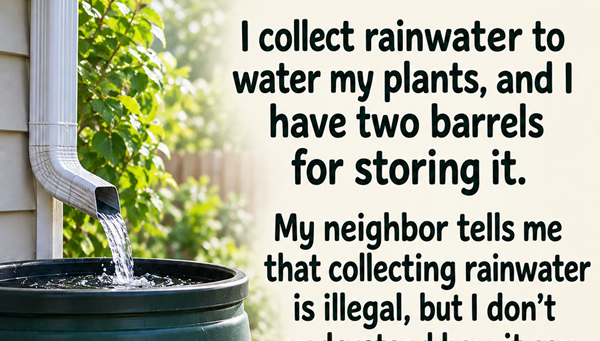
Could something as simple as putting a rain barrel under your gutter actually get you into legal trouble?
It sounds almost absurd. You’re not stealing water, damaging property, or interfering with anyone’s supply. You’re simply collecting rainwater to use later for your garden, lawn, or household chores.
Yet stories about people getting into serious legal trouble over water collection have circulated for years, leaving many homeowners wondering: Can you really go to jail for collecting rainwater?
The short answer is: usually not for using a typical household rain barrel—but water laws can become complicated when large amounts of water are stored or natural waterways are affected.
And one Oregon case is largely responsible for the confusion.
The Oregon Case That Started the Rumor
One of the names most frequently mentioned in discussions about rainwater laws is Gary Harrington, an Oregon resident who became involved in a lengthy dispute with state authorities.
At first glance, his story sounds like a warning against collecting rainwater. But there’s an important detail that often gets lost when the story is retold online.
Harrington wasn’t imprisoned simply because he placed containers underneath his roof gutters.
The dispute involved three large artificial reservoirs on his property. The reservoirs were created using dams and were capable of holding enormous quantities of water. Oregon authorities argued that the structures unlawfully stored water and interfered with water rights protected under state law.
That is a very different situation from putting a 50- or 100-gallon rain barrel beside your house.
Why Does Water Collection Have Laws at All?
To understand why these disputes can become serious, you need to understand how water rights work.
In many parts of the United States, water isn’t treated quite like an ordinary piece of private property. States have developed legal systems to determine who is entitled to use available water and how much they may use.
Oregon, for example, operates under a system heavily influenced by the prior appropriation doctrine. In simplified terms, certain users can have legally recognized rights to use particular water resources.
This matters because water that appears to be “free” may already be part of a legally allocated water system.
If someone constructs a large dam, reservoir, or diversion system that captures substantial amounts of water, that project can potentially interfere with existing water rights.
That’s where the legal concerns become much more significant.
A Rain Barrel Isn’t the Same as a Reservoir
This distinction is the key to understanding the issue.
Imagine two different scenarios.
Scenario 1: The Ordinary Rain Barrel
You install a rain barrel beneath a downspout. Rain falls onto your roof, flows through the gutter, and collects in the barrel.
You use that water later to:
- Water flowers
- Irrigate a garden
- Wash outdoor equipment
- Water the lawn
- Perform other ordinary outdoor tasks
In many jurisdictions, small-scale collection like this is permitted, although local rules can vary.
Scenario 2: A Large Water-Storage System
Now imagine constructing a dam across a drainage channel and creating a large reservoir capable of storing thousands—or millions—of gallons.
That changes the legal picture dramatically.
A project of that scale can potentially alter natural water flows, affect downstream users, interfere with waterways, or implicate established water rights and environmental regulations.
The difference isn’t simply that one person is “collecting rainwater.” The scale, source, location, and method of collection matter.
So, Can Collecting Rainwater Land You in Jail?
For the average homeowner using a conventional rain barrel, jail is not the realistic concern people often make it out to be.
The bigger issue is whether your particular collection system complies with applicable state and local regulations.
Rules can depend on several factors, including:
- How much water you’re collecting
- Where the water comes from
- Whether you’re collecting roof runoff or intercepting a natural waterway
- Whether you’re constructing a pond, dam, or reservoir
- Whether the stored water could affect downstream users
- Local plumbing or building requirements
- State-specific water-rights laws
That’s why an internet claim such as “collecting rainwater is illegal” can be dangerously misleading.
In reality, the answer is usually much more nuanced.
Why State Laws Matter
There isn’t one universal rainwater-collection law that applies everywhere in the United States.
Different states have developed different approaches to rainwater harvesting. Some explicitly allow certain types of collection. Others impose restrictions depending on the size, purpose, location, or method of collection.
Cities and municipalities may also have additional plumbing, construction, or health requirements.
So while your neighbor’s story—or a viral social-media post—might sound convincing, it doesn’t necessarily tell you what is legal on your property.
What Should Homeowners Do?
If you’re thinking about installing a normal rain barrel, don’t panic.
Instead, check the rules that apply where you live.
For a basic system, your local government, water authority, or building/plumbing department may be able to tell you whether any restrictions apply.
If you’re planning something substantially larger—such as a pond, cistern, dam, underground storage system, or major irrigation setup—it’s worth investigating the regulations before construction begins.
A few minutes of research can prevent a much bigger headache later.
The Real Lesson Behind the Rainwater Myth
The story of Gary Harrington is often presented as proof that “you can go to jail for collecting rainwater.”
That’s an oversimplification.
The more accurate lesson is that water rights can become complicated when people capture and store large quantities of water or alter natural water flows.
A small rain barrel catching runoff from your roof is a fundamentally different situation from constructing large reservoirs that hold back substantial amounts of water.
So if you’re wondering whether that modest barrel beneath your gutter is going to land you behind bars, there’s generally no reason to panic.
But before you build something resembling a private lake, check the rules first.
Because when it comes to water rights, the details matter.