 By Admin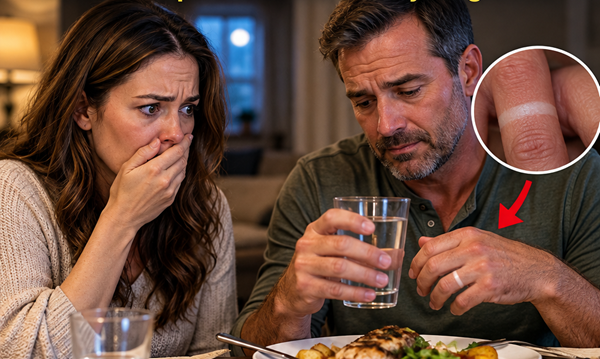
After twenty-six years of marriage, I thought I knew everything about my husband. Then he came home from his annual fishing trip with a pale ring mark on his finger, an unusual silence in his voice, and a secret that would change our lives forever.
Chapter One: The Mark I Couldn’t Explain
I noticed it while Mark was reaching for his glass of water.
It was such a small detail that I might have overlooked it on another day. A pale band of skin circled the base of his left ring finger, standing out against the redness of his sunburned hand.
But I knew that finger.
I knew the crooked knuckle, the faint scar near the nail, and the way he sometimes rubbed the joint when the weather turned cold.
And I knew he hadn’t worn his wedding ring in twelve years.
I slowly put down my fork.
“Mark, what’s that on your finger?”
He stopped chewing.
For a fraction of a second, he looked as though someone had caught him doing something he desperately wanted to hide.
Then he laughed.
“What’s what?”
I pointed toward his hand.
“That mark.”
He turned his hand over and stared at it.
“Oh, that.” He shrugged. “Probably from holding the fishing rod all weekend. The sun hits everything except the part of your hand wrapped around the handle.”
I watched him carefully.
“Really?”
“Of course, really.” He picked up his glass. “This chicken is good, Lee. Did you change the recipe?”
“No.”
“Well, whatever you’re doing, keep doing it.”
He smiled and continued eating.
I didn’t.
My name is Lena Ellison. I’m fifty-one years old, and I’ve been married to Mark for twenty-six years. We have a daughter, Sophie, who’s away at university studying nursing. We’ve survived financial troubles, sleepless nights with a newborn, family arguments, home repairs, and the kind of ordinary disappointments that can either strengthen a marriage or slowly pull it apart.
Mark has always been the person I could read better than anyone else.
I know the difference between his tired smile and his happy one. I know how he scratches the back of his neck when he’s uncomfortable and how he clears his throat when he’s trying to avoid a difficult conversation.
And I know what he looks like when he’s lying.
At dinner that evening, I’d seen a look I’d never seen before.
It wasn’t simply guilt.
It was fear.
And I couldn’t stop wondering what he was afraid I might discover.
Chapter Two: The Fishing Trip That Felt Different
Every August, Mark went fishing with his three closest friends.
Dave had worked alongside him in construction for decades. Ray was the loud one, always telling jokes and posting every detail of his life on social media. Tommy was quieter, a thoughtful man who had stood beside Mark as his best man at our wedding.
For nine years, the trip had followed the same routine.
They left on Friday morning and returned on Sunday evening. They stayed at a modest motel near Loon Lake, spent hours on the water, ate breakfast at a little marina café, and came home with stories about fish that grew larger with every retelling.
Mark always brought me a jar of wild blueberry jam from a roadside farm stand.
Nine years ago, I’d mentioned how much I liked it. He’d remembered ever since.
It wasn’t an expensive gift, but it meant something to me. It was proof that even after decades together, he still paid attention to the little things.
This year, there was no jam.
When Mark came home on Sunday evening, he barely looked at me.
He carried his duffel bag upstairs without stopping to tell me about the trip. When I asked whether Ray had fallen out of the boat again, he paused before answering.
“Twice,” he said.
Usually, that would have made him laugh.
This time, he simply walked away.
At dinner, his answers were short and distracted. He couldn’t remember whether they’d visited their favorite diner. He said Tommy’s knee was doing better, then admitted he hadn’t really asked. When I asked to see pictures of the fish, he said he hadn’t taken many.
I let the questions go, but something inside me remained unsettled.
That night, Mark fell asleep in minutes.
I lay beside him, listening to his steady breathing and watching his left hand rest on the blanket.
The pale stripe was still there.
I tried to convince myself that I was being ridiculous.
People forget things. People get tired. People return from trips in bad moods.
But the explanation about the fishing rod wouldn’t leave my mind.
My father had taught me to fish when I was a child. I’d spent countless Saturdays holding a rod under the summer sun. I’d returned home with blisters, mosquito bites, and dirt beneath my fingernails.
I’d never returned with a perfectly circular mark around my ring finger.
Only a ring could leave a mark like that.
And Mark hadn’t worn one for twelve years.
Chapter Three: The Ring in the Wooden Box
Twelve years earlier, Mark had suffered a serious accident at a construction site.
A steel beam had shifted unexpectedly and crushed his left hand against a concrete column. Dave had called me from the hospital, his voice shaking so badly I could barely understand him.
Mark’s ring finger was broken in three places.
The doctors had to cut off his wedding band before they could treat the injuries.
I remembered sitting beside him in the emergency room as he squeezed my hand through the pain.
When the doctors placed his damaged ring in a small metal tray, Mark looked at it and whispered, “Damn it.”
He wasn’t upset about the jewelry.
He was upset that something he’d worn since our wedding had been destroyed.
We eventually took the ring to a jeweler, who repaired the broken band. But Mark’s finger healed crooked. His knuckle became thick and stiff, and the ring was almost impossible to wear comfortably.
He tried for several weeks.
Then, one night, he sat beside me on our bed and placed it in my palm.
“I’m sorry, Lee,” he said. “I just can’t wear it anymore. It hurts too much.”
I closed my fingers around the gold band.
“It’s okay. It’s only a ring. I know you’re married, and you know you’re married. That’s what matters.”
He kissed my forehead.
We put the ring in a small wooden box his grandfather had made. It had a pine tree carved into the lid, and Mark kept it in the back of his dresser drawer.
It stayed there for twelve years.
I knew because I dusted that dresser every Thursday.
The following morning, after Mark left for work, I walked upstairs and opened the drawer.
My heart was pounding.
I found the wooden box behind his socks and lifted the lid.
There it was.
The old gold ring, scratched and repaired, with its faint soldered seam.
I picked it up and held it against my palm.
Mark hadn’t taken it fishing.
He hadn’t worn it.
Yet something had left a ring-shaped mark on his finger.
I put the ring back into the box and closed the drawer.
For several minutes, I sat on the edge of our bed, staring at the floor.
A horrible possibility had begun to take shape in my mind.
What if Mark had another ring?
And if he did, who had given it to him?
Chapter Four: The Photograph That Changed Everything
That afternoon, Sophie called me on her way back from class.
“Hey, Mom! Did Dad get home okay?”
“He did.”
“Did he tell you about Ray falling out of the boat twice?”
I smiled faintly.
“Yes. Apparently, Ray is still determined to make fishing dangerous for everyone.”
Sophie laughed, but her tone changed a moment later.
“Is Dad okay, though?”
“Why wouldn’t he be?”
“I don’t know. He seemed strange when I texted him on Saturday. I asked him for pictures of the fish, and he didn’t send any. He just wrote, ‘Love you, kiddo.’”
My stomach tightened.
“He’s probably tired.”
“Maybe. Tell him I said hi.”
After we hung up, I sat at the kitchen table and opened my phone.
Ray’s social media page was full of photographs from the trip.
There were pictures of the lake at sunrise, Dave holding up a bass, Tommy asleep in a lawn chair, and the four men gathered around a campfire.
I scrolled slowly.
Mark appeared in only two photographs.
In one, he was sitting in the boat with his left hand hidden inside his jacket pocket.
In another, he stood beside his friends for a group photograph, his left hand tucked behind his back.
I zoomed in, but the image became too blurry to reveal anything.
Then I found a photograph taken at the marina café on Saturday morning.
The caption read:
Breakfast of champions! Ready for another day on the water!
Three men sat around the table.
Dave. Ray. Tommy.
Mark was missing.
I counted the plates.
There were four.
One breakfast sat untouched at the end of the table, beside a cup of coffee.
I stared at the picture until my eyes began to hurt.
Maybe Mark had gone to the restroom. Perhaps he’d stepped outside to take a phone call.
There were innocent explanations.
But the photograph didn’t explain the ring mark. It didn’t explain his silence or the missing jam. It didn’t explain why my husband suddenly seemed like a stranger.
I found the café’s phone number and called.
A woman answered.
“Gull’s Nest, this is Carol.”
“Hello,” I said. “My husband visited your café on Saturday morning with some friends. He thinks he might have left his sunglasses behind.”
“Of course, hon. What’s his name?”
“Mark Ellison.”
The line went quiet.
I waited.
Then the woman asked a question that made the blood drain from my face.
“Are you his wife?”
“Yes,” I whispered.
Another silence followed.
“Oh,” she said softly. “Oh, honey.”
I couldn’t breathe properly.
Why would a woman three hours away ask whether I was my husband’s wife?
Why did she sound as though she felt sorry for me?
And what did she know that I didn’t?
I hung up before she could say another word.
For the first time in twenty-six years, I wondered whether my marriage had been built on a lie.
Chapter Five: The Receipt in His Bag
That evening, Mark came home cheerful.
He asked about my day, helped set the table, and told me a long story about a delivery driver who had accidentally backed into a portable toilet at work.
He laughed at his own joke.
I watched him, wondering how someone could look so normal while concealing something that might destroy an entire marriage.
After dinner, we watched television together. He put his arm around my shoulders, and I rested my head against his chest.
I could hear his heartbeat.
It was familiar. Comforting.
And yet, I felt as though I were sitting beside someone I no longer understood.
He fell asleep at ten fourteen.
A little later, I noticed his duffel bag still sitting in the closet. Mark usually unpacked immediately after returning from a trip, but this time he’d left everything inside.
I carried the bag into the hallway and opened it.
There were dirty clothes, fishing equipment, sunscreen, and his shaving kit.
Nothing unusual.
Then I felt something inside a side pocket.
A plastic key card.
It belonged to the Lakeview Inn, a beautiful old hotel overlooking Loon Lake.
I recognized the name immediately.
Mark and I had spent our honeymoon there twenty-six years earlier.
We’d stayed in Room 12, where the bedroom window looked out across the water.
My fingers began to tremble.
Why did Mark have a key card to the hotel where we’d spent our honeymoon?
I searched the pocket again and found a folded receipt.
It was from a jewelry store in a nearby town.
The date was Saturday morning, at almost exactly the time his friends had been eating breakfast without him.
The amount was more than two thousand dollars.
The receipt listed a custom order, with the balance paid.
On the back, someone had written:
“Ready September 14. Engraving as requested. Congratulations, Mr. Ellison.”
I sat on the hallway floor.
The ring mark. The hotel. The expensive jewelry.
Every piece of evidence seemed to point toward the same conclusion.
I imagined Mark sitting in that hotel room with another woman. I imagined him buying her a ring, making promises, and creating a life that had nothing to do with me.
I wanted to wake him and demand an explanation.
But I was terrified of what he might say.
So I put everything back exactly where I’d found it.
Then I went into the bathroom, locked the door, and cried into a towel so he wouldn’t hear me.
I cried for the years we’d shared.
For the daughter we’d raised.
For the young couple who’d once sat beside a lake and believed they would always belong to each other.
And I cried because I was afraid that everything I thought I knew about my husband might be wrong.
Chapter Six: The Folder on His Computer
I barely slept that night.
At four in the morning, I stood by the bedroom window and watched the empty street.
I decided that I would find the truth the following day.
When Mark left for work, I went into his small home office.
His old laptop sat on the desk.
I opened it and entered the password he’d used for years.
It was incorrect.
My heart began to race.
Mark had never changed his password without telling me.
I tried our wedding anniversary.
Then his grandfather’s name.
Both attempts failed.
I sat back in the chair and pressed my hands against my face.
Think, Lena.
What mattered most to Mark right now?
The lake.
I typed the name of our favorite place.
LoonLake.
The computer unlocked.
For a moment, I felt sick with anticipation. I didn’t know whether I wanted to find proof of an affair or discover that I’d been wrong.
Then I noticed a folder on the desktop.
It had no ordinary name, just a small gold ring as its icon.
I clicked it.
Inside were photographs, documents, a spreadsheet, and several videos.
At the top of the list was a file titled:
START HERE — FOR LEE.
I stared at my name.
Then I pressed play.
Mark appeared on the screen, sitting in the same office where I was now sitting.
His face looked tired. His eyes were red, and his hands trembled as he looked into the camera.
“Hi, Lee.”
He swallowed.
“If you’re watching this, then I need to tell you something. I’ve been trying to find the courage to say it to you in person, but I keep practicing, and every time I do, I lose my nerve.”
He looked down at his hands.
“Five months ago, I went to the doctor because I was forgetting things.”
I leaned closer to the screen.
“At first, I thought it was stress. I’d forget names or measurements at work. One morning, I drove toward a job site I’d visited every day for weeks, and suddenly I didn’t know which way to turn.”
His voice broke.
“They ran tests. Brain scans. Memory tests. Blood work.”
He stopped speaking for several seconds.
Then he looked directly into the camera.
“It’s early-onset Alzheimer’s, Lee.”
The room seemed to tilt around me.
I covered my mouth with both hands.
Mark wiped his eyes.
“The doctor says I might have good years ahead of me. There are treatments that may help slow things down. But she also told me that the illness will progress.”
He took a shaky breath.
“One day, I might forget things I never thought I could forget.”
His eyes filled with tears.
“One day, I might forget you.”
I began to sob.
For days, I’d imagined another woman. I’d imagined betrayal, secret meetings, and a second life.
But the man on my screen wasn’t hiding another relationship.
He was terrified of losing the memories that made him who he was.
And he had been carrying that fear alone for five months.
“I’m sorry I didn’t tell you,” he whispered. “I didn’t want you to watch me every time I forgot something. I didn’t want you to look at me differently.”
He gave a broken smile.
“I love you, Lee. I’ve loved you since you laughed at that terrible drawing I made in your uncle’s hardware store. Whatever happens, I need you to know that.”
The video ended.
I sat motionless.
Then I pressed play again.
And again.
I cried because my husband was sick. I cried because I’d suspected him of betraying me. And I cried because he’d been planning something beautiful while trying to prepare himself for a future that frightened him more than he could explain.
Chapter Seven: The Meaning of the Ring
I forced myself to open the remaining files.
One contained photographs from our wedding. Another held a list of arrangements for September 20.
There were notes about flowers, music, hotel reservations, and a ceremony by the lake.
At the top of the spreadsheet, Mark had written:
MARRY LEE AGAIN. WHILE I STILL REMEMBER WHY.
I read those words until I could no longer see them clearly.
The ring mark finally made sense.
The jewelry store had made a special ring designed to fit over Mark’s damaged knuckle. He’d been wearing a temporary version during the fishing trip to test whether it would be comfortable.
The hotel reservation was for Room 12, where we’d spent our honeymoon.
He wanted to bring me back to the place where our marriage had begun.
The café owner had known because Mark had asked her to help arrange the ceremony. When I called, she had assumed I’d discovered the surprise.
That’s why she’d asked whether I was his wife.
That’s why she’d sounded so sorry.
I wiped my eyes and opened another video.
Mark stood outdoors beside the lake, holding up his left hand.
A gold band circled his finger.
“Look at this,” he said, smiling. “The jeweler made a test version, and it doesn’t hurt.”
He turned his hand toward the camera.
“It’s got a little hinge, so it opens over the knuckle. I can wear it without forcing it over the joint.”
He studied the ring for a moment.
“The doctor says routines can help. Familiar things. Things you do every day.”
His smile softened.
“So I’m going to wear this every day. Maybe one day, when my memory gets worse, I’ll look down at my hand and know that something important is there.”
He looked into the camera.
“Maybe I won’t remember the whole story. But I hope I’ll remember how it feels to be loved.”
Then he laughed quietly.
“See you soon, Lee. And please act surprised.”
I covered my face.
My husband had been preparing to renew his vows with me while I was imagining the end of our marriage.
I had been so frightened of losing him that I hadn’t realized he was already frightened of losing himself.
And then my phone rang.
It was Mark.
Chapter Eight: The Call I Will Never Forget
“Mark?”
There was wind on the other end of the line.
“Lee,” he whispered. “Is that you?”
“Yes, honey. What’s wrong?”
“I don’t know where I am.”
My heart stopped.
He explained that he’d been driving to a construction site when he suddenly realized he didn’t recognize the road.
He had pulled into a gas station and parked his truck.
“I’ve been sitting here for a long time,” he said. “I don’t know how long.”
I gripped the edge of the kitchen table.
“Can you see a street sign?”
He paused.
“Route 9 North.”
Route 9 was the road leading toward Loon Lake.
He’d been driving in the wrong direction for nearly two hours.
“Mark, listen to me. Stay where you are. Lock your doors. Don’t try to drive anywhere.”
“Lee,” he whispered, his voice breaking. “I’m scared.”
I grabbed my keys and purse.
“I know, baby. I’m coming to get you.”
I drove as quickly as I safely could, keeping him on the phone the entire way.
We talked about Sophie, the neighbors, and the bathroom we’d been planning to repaint. Sometimes he spoke clearly. Other times, he went quiet, and I had to ask whether he was still there.
When I finally reached the gas station, I saw his truck parked beside the building.
Mark was sitting behind the steering wheel, staring through the windshield.
For one terrible moment, I was afraid he wouldn’t recognize me.
Then he saw me.
His face crumpled.
He unlocked the door, stepped out, and rushed into my arms.
“I’m sorry,” he kept saying. “I’m so sorry.”
I held him tightly.
“Yes, I’m angry,” I whispered. “I’m angry that you kept this from me. I’m angry that you thought you had to face it alone.”
He lowered his head.
“I didn’t want you to look at me differently.”
I touched his cheek.
“Mark, this is my face when I love someone and I’m frightened for them. It’s not a face of disappointment.”
He closed his eyes.
“You’re not going to leave?”
I took both his hands.
“No. But we’re going to face this together. No more secrets. Not about something this important.”
He nodded against my shoulder.
That afternoon, I drove him home.
We arranged for someone else to retrieve his truck, and we agreed he wouldn’t drive again until we’d spoken with his doctor and made a safe plan.
For the first time since his diagnosis, Mark didn’t have to pretend he was fine.
And for the first time, I understood that loving someone sometimes means letting the truth hurt you rather than allowing fear to keep you apart.
Chapter Nine: Telling Our Daughter
We told Sophie that Saturday.
She drove home from university, still wearing her nursing-school sweatshirt, and sat at the kitchen table with us.
Mark had written down what he wanted to say, but his hands shook too much for him to read the notes.
So I held his hand and explained the diagnosis.
Sophie listened without interrupting.
Then the questions began.
What had the doctor said? What treatments were available? What would happen next? What changes should we expect?
Mark answered what he could. I promised that we would arrange another appointment so Sophie could hear everything directly from his medical team.
For several minutes, she remained composed.
Then she looked at her father.
“Daddy?”
She hadn’t called him that since she was a little girl.
Mark reached for her.
She began to cry.
He wrapped his arms around her and held her as he had when she was small enough to fall asleep on his chest.
“It’s okay, kiddo,” he whispered. “I’m still here.”
“But what if you forget me?”
His face tightened.
“I might have difficult days. I can’t promise what the future will look like. But we’re going to make the most of the time we have, and I’m going to love you for every moment I can.”
Sophie wiped her eyes.
Then she looked at me.
“Mom, what about the ring? You said you found a folder.”
Mark gave me a nervous smile.
“I have a question for you,” he told her. “Will you help me get ready to marry your mother again?”
Sophie stared at him.
Then, through her tears, she laughed.
“You’re unbelievable, Dad.”
“I’ve been told.”
She threw her arms around his neck.
“Of course I’ll help.”
For the first time in weeks, the three of us sat together without anyone pretending that nothing was wrong.
We were frightened, but we were together.
And that was a beginning.
Chapter Ten: The Day We Chose Each Other Again
September 20 arrived beneath a clear blue sky.
Sophie helped me choose a pale blue dress that reminded me of the lake on a quiet morning. Mark had asked her to choose because he knew that if he tried, I’d probably end up wearing the same dress I used for Sunday dinners.
“He wants you to look beautiful,” Sophie told me.
“He thinks khakis count as formal clothing.”
“That’s exactly why I’m in charge.”
We both laughed.
Then we cried.
At five in the afternoon, we walked down to the Gull’s Nest.
White daisies decorated the deck. Small lights hung along the railing, and folding chairs had been arranged beside the water.
Our closest friends were there. Dave stood in the front row wearing a tie that was far too tight. Tommy sat beside him. Ray had already taken out his phone to record everything.
And at the end of the aisle stood Mark.
He wore a dark gray suit and held a small velvet box in his hands.
When he saw me, he began to cry.
I walked toward him, thinking about the young man I’d met twenty-seven years earlier. The man who had drawn a terrible picture of a hinge on a receipt and made me laugh so hard that I nearly lost my breath.
The man who had promised to marry me after knowing me for only eight days.
The man who had built a life with me, one ordinary day at a time.
He took my hands.
“Twenty-six years ago,” he said, “I told a girl I was going to marry her. She thought I was crazy.”
A few people laughed softly.
“She was right. I was crazy about her then, and I’m still crazy about her now.”
He opened the velvet box.
Inside were two gold rings.
Mine was engraved with the words:
Even if I forget — I chose you.
His carried the same message, reminding him that he had been loved and chosen, even when his memory might fail him.
I slipped his ring over his damaged knuckle and closed the tiny hinge.
“Does it hurt?” I whispered.
He looked down at his hand.
“No,” he said softly. “It doesn’t hurt anymore.”
Then he looked at me.
“I can’t promise I’ll remember everything,” he said. “I can’t promise I won’t forget things that matter. But I can tell you that loving you has been the greatest thing I’ve ever done.”
Tears rolled down my cheeks.
When it was my turn to speak, I didn’t need notes.
“When you forget, I’ll remember for both of us. When you don’t know my name, I’ll tell you. When you don’t know where you are, I’ll help you find your way. And when you forget our story, I’ll tell it to you again.”
I squeezed his hands.
“You chose me once. Today, knowing everything, I’m choosing you again.”
He pulled me close.
We kissed as the sun descended over the lake, turning the water gold.
And in that moment, I understood something I’d never fully appreciated during our twenty-six years of marriage.
Love isn’t simply remembering the good times.
It is choosing to stay present when the future becomes frightening.
It is telling the truth when silence feels easier.
And it is learning how to love someone through changes neither of you ever wanted.
Chapter Eleven: Four Years Later
That ceremony took place four years ago.
Mark’s illness has progressed. There are days when he remembers our daughter and tells the same jokes he told when she was little. There are other days when familiar names escape him, and he needs help with ordinary tasks that once came naturally.
We work closely with his medical team and have built routines that help us manage the changes. Sophie visits whenever she can, and we make room for quiet afternoons, old photographs, music, and stories.
Some days are difficult.
I won’t pretend otherwise.
There are moments when grief arrives without warning. Sometimes I miss the man who could repair anything in the house, drive us anywhere without a second thought, and remember every detail of our life together.
Sometimes I sit alone after he’s gone to bed and cry for the future we once imagined.
But there is still laughter in our home.
There are still mornings when Mark smiles at me across the kitchen table. There are still songs that make him tap his fingers against the arm of his chair. There are still moments when he reaches for my hand because something about the gesture feels familiar.
And he still wears his ring.
One afternoon, I found him sitting beside the window, turning the gold band around his finger.
He studied the engraving for a long time.
Then he read the words aloud.
“Even if I forget — she chose me.”
He looked up at me.
“Who is she?”
I sat beside him and took his hand.
“I’m Lena,” I said gently. “Your wife.”
He looked at me for a moment, searching my face.
“Are we happy?”
I felt tears rise in my eyes.
“Yes,” I whispered. “We’ve had a wonderful life together.”
He smiled.
“Tell me about it.”
So I began at the beginning.
I told him about the hardware store, the terrible hinge drawing, the pizza with sticky tables, and the sunset at Loon Lake. I told him about the first time he asked me to marry him and the second time he stood beside the water and promised to choose me again.
I told him about Sophie, about the little house we bought, about the hard years we survived, and about all the ordinary evenings that became extraordinary simply because we spent them together.
He listened quietly.
When I finished, he squeezed my hand.
“You must really love me,” he said.
I leaned over and kissed his cheek.
“I do, Mark. I always have.”
He rested his head against my shoulder.
And for that moment, we were simply two people sitting beside a window, holding hands.
He might not remember every chapter of our story.
But I do.
And as long as I can, I will keep telling it.
Because love is not measured only by the memories we carry.
Sometimes, it is measured by the patience with which we create new moments, the kindness with which we face difficult days, and the courage it takes to choose one another again and again.
If I have learned anything from our journey, it is this: never assume you know the whole story behind someone’s silence. Ask the difficult questions. Tell the truth. Treasure the ordinary days. And when someone you love is frightened by the future, don’t make them face it alone.
Our story didn’t turn out the way I expected.
But it taught me that love can survive uncertainty, that honesty can bring two people closer, and that even when memories begin to fade, the care we show one another can still make a difference.
I cannot promise that tomorrow will be easy.
I can only promise that, for as long as I am able, I will sit beside my husband, hold his hand, and remind him of the life we built together.
And whenever he asks me who I am, I’ll smile and tell him the truth.
“I’m Lena, your wife.”
Then I’ll tell him our story again.
And again.
And again.