 By Admin
 Tyler’s brow furrowed. “What matters?”
“First — you’re leaving this house today.”
His face went blank. “What?”
“You heard her,” Richard said.
Tyler let out a nervous laugh. “No. No, you’ve got this wrong somehow.”
Ms. Harrison didn’t flinch. “You don’t own this property.”
“I live here.”
“That’s not the same thing.”
“I’ve lived here for years.”
“Because your mother allowed it.”
Tyler looked at me. “Mom?”
I made myself hold his gaze. “You’re leaving today.”
His mouth opened. Nothing came out. Then the anger surfaced — right on schedule.
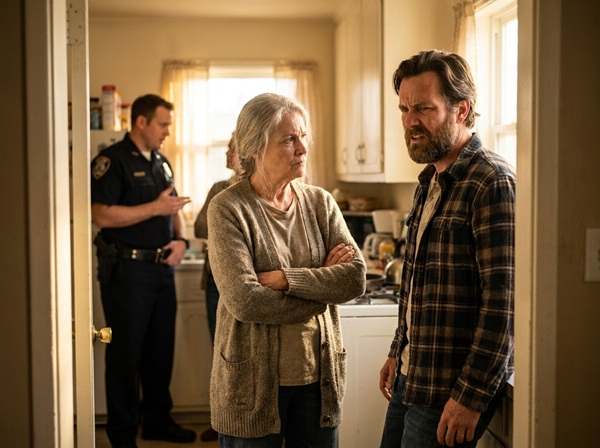
“You’re throwing me out?”
“No.”
His face twisted. “You just said—”
“I’m asking you to leave a house you’ve lived in without paying a cent toward.”
“You’re my mother!”
“And I’m still your mother.”
“Then how can you do this?”
My throat tightened. “Because I am your mother.”
He stared at me, not understanding. Not yet. So I kept going.
“Being your mother doesn’t mean I have to let you hurt me.”
Tyler slammed his palm on the table. The plates rattled. One of the officers stepped forward instantly. Tyler froze.
The silence that followed felt different from the silence after the slap.
This time, I wasn’t afraid.
I was watching. And for the first time, other people were watching too.
Tyler slowly lowered his hand. “I’m sorry,” he muttered.
“For what?”
He hesitated. “For hitting you.”
“Why are you sorry?”
His jaw tightened. “Because I shouldn’t have.”
“Because you shouldn’t have,” I repeated, “or because you just realized there are consequences?”
His eyes flared with frustration. “Does it matter?”
“Yes.”
He looked away.
Something inside me quietly died in that moment. Not my love for him — something more complicated. The illusion. The illusion that one day he’d wake up and understand what he’d done. That one day I wouldn’t have to force it. That my patience would somehow teach him kindness on its own.
I’d waited years for that day.
It wasn’t coming.
Ms. Harrison turned a page. “There’s something else.”
Tyler looked at her. “What?”
She pulled out several sheets. “Copies of the mortgage, the deed, and the financial records tied to this home.”
“So?”
“So your mother is the sole owner.”
“I know that.”
“You may know it,” she said, “but according to these documents, you recently represented yourself to another party as having an ownership stake in this property.”
Tyler’s expression shifted.
Richard turned to him. “What did you do?”
“I didn’t do anything.”
Ms. Harrison slid a document across the table. “Then perhaps you’d explain this.”
Tyler didn’t touch it. His eyes moved over the page. His face drained of color.
“What is it?” I asked.
Ms. Harrison answered for him. “A loan application.”
Tyler looked at her. Then at me. “I can explain.”
My stomach dropped. “A loan for what?”
He said nothing.
Richard leaned in. “For how much?”
Tyler’s jaw clenched. “It’s not what you think.”
Ms. Harrison said it quietly. “Twenty-eight thousand dollars.”
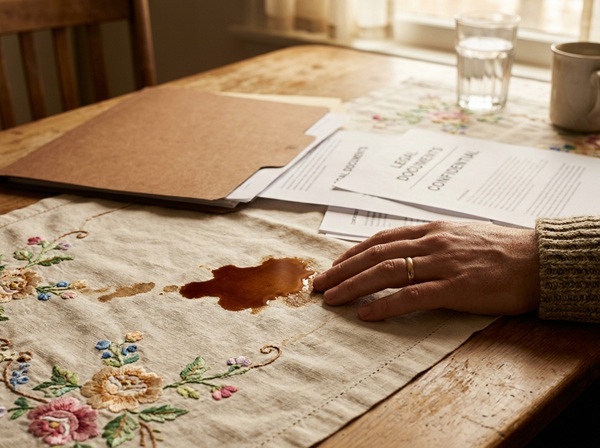
The coffee cup slipped from my hand. It didn’t shatter — just tipped onto its side on the tablecloth, coffee bleeding across the embroidered flowers.
My mother’s tablecloth. The one I’d pulled out because I believed this morning would mark an ending.
I stared at the stain. “Twenty-eight thousand?”
“I wasn’t going to take the house,” Tyler said immediately.
“Then why did you use it as collateral?”
Nothing.
“Tyler.”
“I needed the money.”
“For what?”
Silence.
Richard’s voice went cold. “Drugs?”
“No!”
“Gambling?”
“No!”
“Then what?”
Tyler stood there breathing hard. Finally: “I owed people.”
Nobody moved. The kitchen felt cold despite the warmth. “What people?”
“I said I owed people.”
“Who?”
“Mom, just drop it.”
“No.”
His eyes narrowed. “You don’t understand.”
“You’re right. I don’t.”
Ms. Harrison closed the folder. “There’s another matter.”
Tyler’s face changed again. “What now?”
She reached into her briefcase — not for paperwork this time. A small sealed white envelope. My name written across it: Margaret Collins.
My hands started shaking. “What’s that?”
“I was told to give this to you only after your son had seen the financial documents.”
Tyler stared at the envelope. “What is that?”
“I don’t know,” I said.
She set it in front of me. The handwriting wasn’t familiar. I glanced at Richard — he was staring at it too.
“Open it,” he said.
I hesitated, then tore it open. One sheet of paper inside. I read the first line and everything in me went still.
Mrs. Collins, you don’t know what your son has gotten himself into.
My eyes moved down.
But you aren’t the only one he’s lied to.
I stopped breathing.
Tyler stepped forward. “Give me that.”
I pulled it away. “No.”
“Mom, give it to me.”
“Who wrote this?”
Nothing.
“Tyler, who wrote this?”
“I don’t know.” The lie came too fast.
Ms. Harrison took it from my hand, read it, and her expression shifted. She passed it to Richard. His face hardened.
“What?” I whispered.
He handed it back. “There are dates.”
I looked again. Five of them, all within the last six months. Beside each, an amount: $2,000. $4,500. $1,800. $7,200. $3,000.
“What is this?”
Tyler backed away. “I don’t know.”
“That’s your name.”
“I said I don’t know!”
An officer stepped forward again. Tyler’s shoulders stiffened.
I lowered the page. “Who’s threatening you?”
For a second, I thought he’d finally tell me. Instead: “Nobody.”
Then his phone rang. The sound sliced through the kitchen. Tyler looked at the screen and every trace of color drained from his face. He didn’t answer. It stopped. Rang again.
Richard noticed. “Who is it?”
“No one.”
“Show me.”
“No.”
It rang a third time. Tyler looked at me, and for the first time since he’d come downstairs, I saw something in his eyes worse than his anger.
Desperation.
He stepped back. “I’m going upstairs.”
“No,” an officer said.
He stopped. “I just need my charger.”
“You can get your things later.”
Tyler looked at the staircase. Then the front door. Then me. Trapped.
And I understood — this wasn’t just about my son leaving my house. Something much larger had been happening behind my back. Something he’d been hiding. Something that had followed him into my home.
Something using him. Controlling him. Maybe both.
Ms. Harrison gathered the documents. “Tyler, you need to understand — your mother has already taken legal steps to protect herself.”
“What does that mean?”
“It means, effective now, you can’t access certain accounts, sign anything on her behalf, or use this property in any financial transaction.”
He stared at her, then laughed — a strange, broken sound. “You really did this.”
I said nothing.
“You planned all of this.”
“No.”
“You called Dad.”
“Yes.”
“You called a lawyer.”
“Yes.”
“You called the police.”
“They came because you hit me.”
His eyes filled with rage. “You’re ruining my life.”
I looked at him for a long moment. “No, Tyler.” My voice stayed quiet. “I stopped ruining mine to save yours.”
He flinched. It was the first thing that had actually landed.
Richard stood. “Pack a bag.”
“I’m not leaving.”
“You are.”
“This is my home.”
“No,” I said. He turned toward me. I pointed at the door. “This is my home.”
Simple words. But they carried weight. Twenty-seven years of mortgage payments. Double shifts. Christmases spent counting bills. Birthdays with homemade cakes because store-bought cost too much. The years after the divorce when I worked until my feet ached so Tyler would never feel like he’d lost anything.
All of it stood behind those four words.
Tyler stared at me, then whispered, “You’re really doing this.”
“Yes.”
He walked toward the stairs. An officer watched him closely. At the bottom step, he stopped and looked back.
“Mom?”
I didn’t answer.
He swallowed. “Do you still love me?”
My heart cracked. That was the question I’d feared most — not can I stay, not where will I go, not how will I get money.
That one.
I looked at the son I’d carried. The boy whose fevers I’d sat up through. The teenager whose college applications I’d filled out. The young man whose mistakes I’d quietly paid for. And the adult who’d struck me across the face.
“Yes,” I said.
His eyes filled. “But loving you,” I continued, “doesn’t mean I’ll let you destroy me.”
He stood there several seconds. Then went upstairs.
The house went quiet again. Richard sat down slowly. I stayed standing, my hands cold.
Ms. Harrison said softly, “You did the right thing.”
I nodded. But something still gnawed at me. The letter. The money. The loan. The phone call.
I looked at the brown folder. “There’s more.”
She didn’t answer right away. That was answer enough.
“What haven’t you told me?”
She glanced at Richard, then back at me. “I wanted to wait until Tyler was out of the house.”
My stomach tightened. “Why?”
She pulled out another document — much older, three years old. My name on it. Tyler’s too.
“What is this?”
Richard read over my shoulder, then whispered, “Oh my God.”
“What?”
He didn’t answer.
Ms. Harrison took a breath. “Margaret — three years ago, someone attempted to transfer partial ownership of this property.”
My mouth went dry. “Someone?”
“Yes.”
“Who?”
She glanced toward the staircase, then said the words I never expected. “Your son.”
I couldn’t speak. Richard closed his eyes.
There was a signature on the page. It looked almost like mine. Almost.
But I never signed it.
My hands began to shake. “I don’t understand.”
“You didn’t sign this.”
“Then who did?”
“That’s what we’re trying to determine.”
A crash sounded from upstairs. We all looked toward the ceiling.
Then Tyler shouted — not in anger. In terror.
“Mom!”
I ran for the stairs before anyone could stop me. “Tyler!”
“Mom, don’t come up!”
I froze. Richard grabbed my arm. “Stay here.”
Then another sound — a man’s voice, low, unfamiliar, coming from upstairs. My blood went cold.
Someone else was in my house.
And Tyler wasn’t shouting at him. He was begging him.
“Please.”
The voice answered. “You were supposed to have the money this morning.”
I looked at Richard. His face had gone completely pale. Ms. Harrison reached for her phone. The officers moved toward the stairs.
Then the stranger said something that raised every hair on my arms.
“Your mother wasn’t supposed to be alive when we came for the house.”
My knees buckled. Richard caught me.
“What did he say?” I whispered.
No one answered.
Then Tyler’s voice, crying. “Please don’t hurt her.”
And in that moment, I understood. The slap hadn’t been the beginning. It had been a warning. The brown folder hadn’t been prepared because my son had simply turned violent.
It had been prepared because someone had been watching my house.
Someone had been waiting.
And somehow, Tyler knew exactly who they were.
The police rushed up the stairs. A door slammed. Then a terrible silence.
Then a scream — not Tyler’s. A man’s.
And after that, nothing.
I stood gripping the edge of the table, my mother’s stained tablecloth beneath my hands, the pancakes going cold, the bacon untouched, Tyler’s empty plate still exactly where I’d set it.
For the first time all morning, I understood the strange calm I’d been feeling. Some part of me had already known.
This wasn’t going to be a goodbye.
It was going to be an unveiling.
And whatever was hiding inside that brown folder was only the first layer.
When the officers finally came back down, one of them carried something — a small black notebook. He set it on the table.
“Mrs. Collins,” he said carefully, “you need to see this.”
I opened it. The first page held only names. The second, dates. The third, addresses.
On the fourth page, in Tyler’s handwriting, was my name.
Beneath it, three words:
FINAL TARGET — FRIDAY.
PART 3 — THE NAME IN THE NOTEBOOK
For several seconds nobody touched it. It sat on my mother’s embroidered tablecloth like an accusation.
FINAL TARGET — FRIDAY.
I read it again. Then again. My mind refused to accept what I was seeing.
“That’s Tyler’s handwriting,” I whispered.
The officer nodded. “We believe so.”
Richard pulled out the chair beside me. “Margaret, sit down.”
“I don’t want to sit.” My voice sounded strange — too calm, almost detached. “What does ‘final target’ mean?”
The officer didn’t answer right away. His partner came down carrying an evidence bag — Tyler’s phone inside it.
“Mr. Collins is being held upstairs while we sort out what happened,” the officer said.
“Is the other man still there?”
“No.”
“What do you mean, no?”
“He got away.”
Richard’s face hardened. “How?”
The officers exchanged a look. “There’s a rear exit off the upstairs hallway.”
I looked toward the ceiling. My house. My son’s bedroom. A hidden exit I never knew existed. Suddenly I felt like a stranger in my own home.
Ms. Harrison sat beside me. “Margaret, we need to be careful about assumptions.”
“Someone said they were going to kill me.”
“Yes.”
“Someone tried to use my house as collateral.”
“Yes.”
“My son knew who they were.”
“Yes.”
“And you’re telling me not to assume?”
She took my hand. “I’m telling you we don’t yet know if Tyler was involved willingly.”
That stopped me. Because I remembered his face — not when I told him to leave, not with the police there, not with the paperwork. But when that stranger spoke upstairs.
Tyler had been terrified.
Not for himself.
For me.
“Can I see him?”
The officer shook his head. “Not yet.”
“He’s my son.”
“I understand.”
“He needs me.”
Richard said quietly, “No, Margaret.”
I turned to him.
“He needs someone,” Richard said. “Maybe this time it doesn’t have to be you.”
It hurt because it was true.
I looked back at the notebook — names I recognized, more I didn’t. Then one stopped my heart cold.
Richard Collins.
I slid it toward him. “That’s your name.”
He stared at it, expression shifting, and picked it up slowly. Beside his name, a date six months back. And an amount: $15,000.
“I don’t know what this means,” he said.
I believed him. But the timing unsettled me. “Why would Tyler write your name down?”
He didn’t answer.
Ms. Harrison leaned in. “There may be another explanation. Someone else could have used his notebook.”
“No. That’s his handwriting.”
“Yes.”
“Then Tyler wrote it.”
“Possibly.”
Richard closed it. “Let’s ask him.”
“Not until we’ve spoken to him first,” the officer said.
I stood. “Then I’ll wait.”
“You don’t have to.”
“Yes, I do.”
He looked like he wanted to argue. Instead, he nodded.
I walked into the living room. For the first time in twenty-three years, it felt small. Photographs on the wall — Tyler at five, at twelve, at sixteen, at graduation. A smiling boy. A confused teenager. A young man with his arm around me.
All of it suddenly felt like evidence from another life.
I touched a frame — Tyler at eight, missing his front teeth, hands filthy, gripping a tiny blue bicycle. He’d fallen three times trying to ride it that day. Cried every time. Got back on every time.
“What happened to you?” I whispered.
“I’ve been asking myself that for years,” Richard said behind me.
I turned. He stood in the doorway.
“Don’t.”
“Don’t what?”
“Don’t turn this into what you should have done.”
His eyes dropped. “I should have been there.”
“Yes.”
“I should have seen what was happening.”
“You left.”
“I know.”
“You missed the years he needed you.”
“I know.”
“You left me to raise him alone.”
“I know, Margaret.” His voice broke.
Silence. Then something I never expected. “I was afraid to come back.”
“Why?”
“Because I thought you’d hate me.”
“I did.”
“And now?”
I glanced toward the stairs. “I don’t know what I feel anymore.”
Before he could respond, the front door opened. A detective walked in, introduced himself as Detective Lewis, carrying a thin folder.
“Mrs. Collins?”
“Yes.”
“We need to talk.”
“About Tyler?”
“About Tyler.” He glanced at Richard. “And you must be Mr. Collins.”
“Yes.”
He nodded at the notebook. “Where did you find this?”
“An officer brought it down.”
“We found it in Tyler’s room.”
“What is it?”
“We believe it’s a ledger.”
“Of what?”
“People — people who owed money, lent money, or were being threatened.”
Richard stepped closer. “Was my name in it?”
“Yes.”
“Why?”
“We don’t know yet.”
“Was mine?” I asked.
He hesitated. “Yes.”
My heart sank. “Where?”
“Last page.”
He opened it. There was my name, two dates beneath it — today, and Friday. Beneath Friday, four words:
Transfer complete. House empty.
The room seemed to tilt. “What transfer?”
He looked at Ms. Harrison. She answered. “Property transfer.”
“But Tyler can’t sell my house.”
“No,” she said.
“He can’t sign for me.”
“Not legally.”
“Then what is this?”
Detective Lewis set another document down. “This is where it gets complicated.”
A copy of an electronic property filing. My name. My address. And the buyer listed —
I stopped breathing.
Not Tyler. Not a stranger.
A company. Cedar Ridge Holdings LLC.
“What’s that?”
“A real estate holding company.”
“Who owns it?”
“Still investigating.”
I looked at Richard. He was staring at the page. Then, quietly: “I know that name.”
Everyone looked at him.
“From where?”
He rubbed his forehead. “Three years ago.”
“What happened three years ago?”
“The divorce settlement.”
“What about it?”
“There was a company involved.”
“Which company?”
He said nothing.
“Richard.”
“Cedar Ridge.”
The room went silent. My stomach twisted. “You knew about this?”
“Not exactly.”
“What does that mean?”
He looked ashamed. “My lawyer warned me someone was trying to acquire properties in neighborhoods like yours.”
“Why didn’t you tell me?”
“I thought it had nothing to do with you.”
I laughed bitterly. “Apparently it did.”
Detective Lewis cut in. “Mr. Collins, did you ever deal with anyone connected to Cedar Ridge?”
Richard hesitated. “Yes.”
My heart dropped. “When?”
“About three years ago.”
“Who?”
“I don’t remember his name.”
“You don’t remember?”
“A man approached me about buying a property.”
“Which property?”
He looked at me. “Yours.”
I felt slapped all over again. “You tried to sell my house?”
“No.”
“You just said—”
“I was approached. I refused.”
“Then why would they still be interested?”
He didn’t answer. Detective Lewis did. “Because someone else may have agreed to help them.”
I looked toward the stairs. “Tyler.”
Nobody said anything. The silence said enough.
I started for the stairs. The detective blocked my path.
“No.”
“I need to talk to my son.”
“Mrs. Collins—”
“I need to know why he did this.”
“You need to let us handle it.”
I looked him dead in the eye. “Detective, I’ve been handling Tyler alone for years.”
Then I stopped — because the sentence sounded absurd the second it left my mouth.
I hadn’t been handling him.
I’d been hiding him.
There’s a difference.
I stepped back. “Fine.”
He nodded. Then his phone rang. He answered, and his expression shifted almost instantly.
“Where?” A pause. “Are you sure?” Another pause. “Don’t touch anything. We’re coming.”
He hung up. I knew before he spoke.
“What happened?”
“We found something in Tyler’s room.”
“What?”
“A second phone.”
“He has two?”
“Yes.”
“What’s on it?”
“Haven’t unlocked it yet.”
Richard stepped forward. “Then what did you find?”
“A photograph.” He pulled out an evidence bag — a printed photo inside. He handed it to me.
My house. Taken from across the street. At night. A date stamped in the corner — three weeks ago.
I flipped it over. Handwriting on the back. Three words:
She trusts him.
I looked at Richard. He was staring at the photo. “Who?” I asked, barely audible. “Who does that mean?”
Neither of us spoke. Then Detective Lewis asked, quietly, “Mrs. Collins, is there anyone you trust who’s had recent access to your home?”
I thought. My neighbors. My attorney. My ex-husband. My son.
The question seemed simple. Then another memory surfaced — six months back, Tyler introducing me to someone. A man I barely remembered. He’d shaken my hand. Smiled.
“Mom, this is someone who can help me.”
I closed my eyes. I remembered his voice. The same calm. The same cold confidence.
My eyes opened. “I know him.”
Detective Lewis leaned in. “Who?”
I whispered the name. Richard’s face went white.
Because he knew him too.
The man wasn’t a stranger. He was the same one who’d approached Richard three years ago about buying my house. The same name that appeared nowhere in the paperwork. The same person Tyler had apparently been working with.
The same person who’d just escaped through the back of my house.
Detective Lewis called for his officers immediately, then turned to me. “Mrs. Collins, I need you to leave the property.”
“What?”
“Now.”
“Why?”
He glanced at the windows. “If this person has been watching your house for three weeks, we don’t know if he came alone.”
My blood ran cold. Richard grabbed his jacket. “We’re leaving.”
Before I could move, I heard it — a faint vibration from the kitchen. My phone, on the table. Unknown number.
Everyone froze.
Detective Lewis stared at it. “Don’t answer.”
It stopped ringing. Then a text appeared. I could read it from where I stood.
Six words:
You should have left last night.
My knees weakened. A second message:
Now ask Richard what he did.
I turned slowly toward my ex-husband. He wasn’t looking at the phone.
He was looking at me.
And for the first time all morning, I saw something in his eyes I’d never seen before.
Guilt.
Not fear. Not surprise.
Guilt.
“Richard?”
He closed his eyes. “Margaret…”
“What did you do?”
Silence.
I stepped toward him. “What did you do three years ago?”
He finally opened his eyes, and the man I’d divorced twenty-seven years earlier looked at me like he was about to confess something that would destroy everything I thought I knew about my family.
“I didn’t refuse their offer,” he whispered.
My heart stopped.
“I accepted it.”
The room went silent. Detective Lewis reached for his radio.
Richard looked at me. “But I never sold the house.”
“Then what did you sell?”
He swallowed.
“My silence.”
Before I could ask what that meant, every light in the house went out.
The kitchen dropped into darkness.
Then, from upstairs, Tyler screamed one word:
“DAD!”
And something heavy slammed against the bedroom door.
THE END