 By Admin
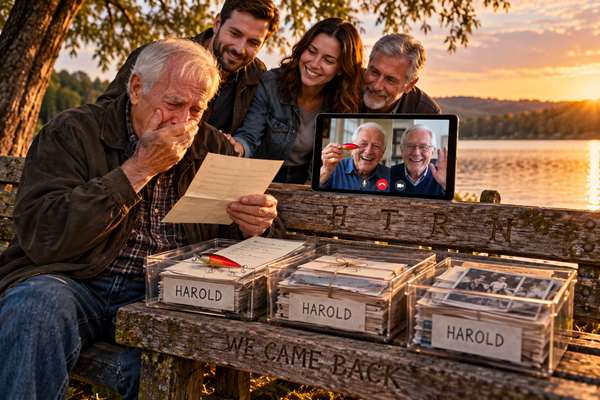
Three boxes were waiting on the old wooden bench when I arrived at the lake.
I was seventy-two years old, and I hadn’t stood in that exact spot since the summer of 1970. Yet there they were, resting beneath the same willow tree where four seventeen-year-old boys had once promised to return fifty-five years later.
Each box had a clear lid. Each carried the same handwritten name.
HAROLD.
My hands began to tremble when I noticed the initials carved into the bench: H, T, R, and N.
Ours.
Inside the first box lay a faded red fishing lure. I recognized it immediately. Tommy had bought it for $3.50 during the summer we spent nearly every afternoon fishing for bass. We had argued over whose turn it was to use it, laughed when it snagged on a branch, and eventually lost it somewhere along the shoreline.
Or so I had believed.
Beneath the lure rested a letter dated seven months earlier.
I unfolded it carefully.
Harold,
I wish we’d had the courage to ask why you stopped writing.
I read that sentence three times.
Then I sat down.
Because the truth was, I had spent more than fifty years wondering why they had stopped writing to me.
We had been inseparable as boys.
Tommy dreamed of seeing the world. Ray wanted to become a businessman. Nick could make anyone laugh, even when life gave us very little to laugh about.
And I was Harold, the boy who expected to spend his entire life in the town where he was born.
On our graduation night in 1970, we gathered beside the lake and stacked our hands together.
“No matter where life takes us,” Tommy had said, “we come back here in fifty-five years.”
Ray laughed. “We’ll probably need walking sticks by then.”
Nick grinned. “Speak for yourself. I’ll still be catching fish.”
We carved our initials into the bench and made our promise.
Then life began pulling us in different directions.
Tommy moved to Australia. Ray found work in Germany. Nick eventually settled in Portugal.
I stayed behind to help my father run his hardware store. He paid me $85 a week, and I convinced myself that remaining home was the responsible thing to do.
At first, letters arrived regularly.
Tommy wrote about unfamiliar cities and the strange foods he tried. Ray sent photographs of his new life. Nick filled his pages with jokes and stories that made me laugh aloud.
I answered every letter.
Then, gradually, their messages stopped coming.
I wrote again. And again.
Eventually, I stopped.
I assumed they had built new lives and forgotten the boy who had never left home.
But standing beside the lake that afternoon, I began to understand that perhaps I had been wrong.
I opened the second box.
Inside lay eleven letters, all addressed to me.
The earliest was dated 1971. The latest was from 1974.
My name appeared on every envelope, written in handwriting I would have recognized anywhere.
Ray’s.
With shaking fingers, I opened the first letter.
Harold,
We haven’t heard from you in months. Did we do something to upset you? If you’re angry, please tell us. We’re your friends. Whatever happened, we can work it out.
The next letter was more desperate.
I don’t understand why you won’t answer. Tommy thinks you’ve decided you don’t want us in your life anymore. I keep telling him there must be another explanation.
Then came another.
And another.
Each one carried the same unanswered question.
Why did you leave us?
Tears blurred the words.
I had never left them.
I had waited for their letters until waiting itself became too painful.
At the bottom of the box lay a note from Ray’s daughter. She explained that her father had died three years earlier and had left specific instructions in his estate papers: his letters were to be delivered to the old lakeside bench on the day of our fifty-fifth anniversary.
I pressed the letters against my chest.
Ray had carried that unanswered question for decades.
And I had spent those same decades believing he no longer cared.
The third box contained Nick’s letters, photographs, and copies of old correspondence.
As I read through them, a memory surfaced that I had tried not to revisit.
My father standing behind the hardware store counter, sorting through the mail.
Me asking whether anything had arrived.
His answer always seemed the same.
“Nothing for you today, Harold.”
At the time, I had believed him.
Now I remembered how he had reacted when I announced that I wanted to join Tommy overseas. He had grown pale with anger and reminded me that the store was struggling, the mortgage was overdue, and my mother depended on the income we earned.
“You can’t abandon your family,” he had told me.
I had stayed.
For years, I believed that decision had been mine.
But as I sat on the bench, surrounded by letters my friends had written, a terrible possibility took shape.
My father had been collecting our mail.
And he had been hiding it.
Later, I would discover that the suspicion was true.
An attorney reviewing my father’s old estate papers found a sealed envelope containing several original letters and a handwritten apology. My father had admitted that he had intercepted the correspondence because he feared I would leave the family business.
He had worried about the store’s debts, the mortgage, his modest investments, and how my mother would survive without my help.
He had convinced himself that keeping me home was an act of love.
But love without honesty had become a prison none of us knew existed.
My father had protected the business.
And in doing so, he had broken four boys’ hearts.
There was no way to recover the birthdays, ordinary conversations, family celebrations, and quiet afternoons we might have shared.
No apology could return fifty-five years.
Still, I wanted to believe that the truth might give us something the silence never had.
A chance to begin again.
I was reading the final letter when I heard footsteps behind me.
A shadow fell across the bench.
“Harold?”
I turned.
A man stood a few feet away, holding a tablet. Beside him were a young woman and an older man I didn’t recognize.
The stranger smiled gently.
“My name is Daniel. I’m Tommy’s son. This is Nick’s daughter, Sarah, and Ray’s grandson, Michael.”
I struggled to speak.
“Your fathers and grandfathers knew about the promise?” I asked.
Daniel nodded.
“Tommy and Nick are still alive, but traveling here wasn’t possible for them. Dad asked us to bring the boxes. And there’s something else.”
He turned the tablet toward me.
Two familiar faces appeared on the screen.
Tommy.
Nick.
Their hair had turned white. Their faces were lined with age. But their eyes were the same eyes I remembered from the summer of 1970.
For several seconds, nobody spoke.
Then Tommy lifted something toward the camera.
The red fishing lure.
“Well, Harold,” he said, his voice breaking into a laugh, “after all these years, this thing still hasn’t caught a decent fish.”
I laughed so suddenly that it came out as a sob.
Nick wiped his eyes.
“You stubborn old fool,” he said. “We thought you’d forgotten us.”
“I thought you had forgotten me,” I replied.
And then we all began talking at once.
We asked questions that had waited decades for answers. We apologized for things none of us had actually done. We shared stories about our children, our jobs, our marriages, our disappointments, and the people we had loved and lost.
We spoke until the afternoon sun slipped behind the trees.
For the first time in fifty-five years, the silence between us was gone.
Before Daniel and the others left, I asked for a pocketknife.
Together, we knelt beside the bench.
Below our old initials, we carved four simple words:
WE CAME BACK.
My hands were unsteady, and the letters were crooked. But I didn’t care.
I had spent much of my life believing that some promises were too old to keep and some friendships too distant to save.
That afternoon taught me otherwise.
We couldn’t reclaim the years we’d lost. We couldn’t undo my father’s choices or erase the pain his fear had caused.
But we could stop carrying the blame.
We could tell the truth.
And we could make sure the next generation understood that silence is not always rejection, that unanswered letters do not always mean forgotten love, and that sometimes the people we believe have abandoned us are waiting just as desperately for us to return.
As I walked away from the lake, I looked back one last time.
The three boxes rested beneath the willow tree.
Our initials remained carved in the wood.
And for the first time in more than half a century, I no longer felt like the boy who had been left behind.
I felt like a friend who had finally found his way home.