 By Admin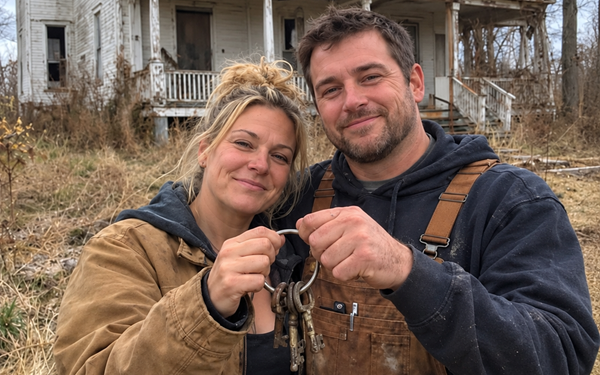
The envelopes were waiting beneath the Easter plates, one at every place setting. Each had a name written on the front in my mother-in-law’s familiar, rounded handwriting.
Kim opened hers first.
She was the oldest of the three siblings, divorced for two years and raising two boys in a rented trailer behind the grain elevator. When she pulled the contents from the envelope, she stared at the paper for several seconds before covering her mouth with one hand.
Then Jeff opened his.
He had lost his job at the Caterpillar plant the previous fall and was now driving a propane truck part-time. He read the letter inside his envelope, lifted his eyes toward his father, and seemed unable to find the words to speak.
Finally, Stacy, the youngest at twenty-six, opened hers. She had been struggling with nursing school loans, and the moment she saw what her parents had given her, tears began rolling down her cheeks.
Ron, my father-in-law, sat proudly at the head of the table with one hand resting on the back of his wife Judy’s chair.
“Twenty thousand dollars each,” he announced. “Your mother and I sold the forty acres down by the creek. We want to see you kids settled while we’re still around to enjoy it.”
Everyone stood up at once.
There were hugs, tears, laughter, and excited questions about houses and mortgages. Kim’s boys wanted to know what was happening, while their mother tried to explain through her tears.
The ham sat forgotten on the table, growing cold beside the scalloped potatoes.
And then there was Nate and me.
We had one envelope between us.
I slid my thumb beneath the flap and opened it carefully.
Inside was a greeting card with a bluebird on the front.
I opened it.
My mother-in-law had written:
You two have always been so capable. We never worry about you. Love, Mom and Dad.
That was all.
No check. No cash. No explanation.
Just a card.
I looked inside the envelope again. Then I checked the card, front and back, because I work as a hospital billing clerk, and checking things twice is practically part of my personality.
Nothing.
I slipped the card to Nate beneath the edge of the tablecloth.
He read it once.
Then he read it again, more slowly.
Without saying a word, he folded it neatly and placed it in his shirt pocket.
His ears turned red.
I knew that expression. It was the same one he wore when a bolt snapped in his hand or a customer spoke down to him as though being a mechanic made him less of a man.
Ron lifted his coffee cup toward us.
“That’s the truth about you two,” he said cheerfully. “Take it as a compliment. You’ve never given us one day’s worry. Either one of you.”
Judy beamed at me.
And the hardest part was that she meant every word.
She genuinely believed she had given us something wonderful. In her mind, that little bluebird card was a way of telling us how proud she was that we had managed so well on our own.
I sat there surrounded by the smell of Easter lilies, warm bread, and a dinner that had taken her hours to prepare, trying to figure out how to feel.
I could have asked why.
The question sat right behind my teeth.
Why did the other children deserve help buying houses while we received a greeting card?
But there is something about asking for money that makes you feel as though you’ve already lost something. And it was Easter Sunday. Judy had been cooking since five in the morning, and I wasn’t about to turn her dining room into a courtroom.
So I smiled.
“Thank you,” I said. “It’s a lovely card.”
Then I passed the rolls to Kim.
And I want to make something clear: I was happy for her. I was happy for Jeff and Stacy, too.
Kim’s boys were sleeping in one bed. Jeff was trying to recover from losing his job. Stacy was carrying the burden of student loans while trying to build a future for herself.
They needed help.
I didn’t resent them for receiving it.
What hurt was the realization that Nate and I had somehow become the children who didn’t need anything.
My name is Emily Schafer. I was thirty-three that Easter, and my husband, Nate, was thirty-four.
Nate didn’t criticize his parents during dinner. He ate his meal, helped his father carry the folding chairs down to the basement, and kissed Judy on the cheek when we left.
He didn’t mention the card in the truck, either.
Not until we had passed the city limits sign and the road opened onto dark farmland, the freshly worked fields stretching away on both sides.
“How much do we have saved?” he asked.
“Six thousand two hundred dollars.”
I didn’t need to check our account.
“What are we paying in rent?”
“Seven hundred and twenty-five a month.”
He drove in silence for a while.
Nate is a diesel mechanic. He approaches problems the same way he approaches a broken engine: find out what’s wrong before deciding what to do about it.
Finally, he spoke.
“I’m not mad at Kim.”
“I know.”
“I’m not even sure I’m mad at my parents. They think they did something nice.”
“They did say something nice.”
“Yeah.”
He reached into his shirt pocket and pulled out the greeting card. He placed it on the dashboard, bluebird facing up.
“I’d just like to be worried about one time,” he said quietly. “Just once. I’d like to know what it feels like to have someone worry about us.”
That sentence broke my heart more than the empty envelope had.
I laughed at first, because sometimes laughter is the only thing you can manage when the truth hurts.
Then the laughter disappeared.
I turned toward the window so Nate wouldn’t have to watch me wipe my eyes.
A few miles later, he spoke again.
“Then we need to make more money.”
I looked at him.
“I can take harvest calls,” he continued. “Field service, emergency repairs. Farmers will pay good money to get a combine running at ten o’clock at night.”
“I can work at the diner,” I said. “Patty’s been asking me to wait tables at the truck stop for a year.”
“You’re on your feet all week.”
“I sit all week,” I reminded him. “That’s the problem with billing.”
That was our entire discussion.
No grand speech. No promises that everything would be easy. No dramatic declaration about proving his parents wrong.
Just two people sitting in an old truck, looking at their bank balance and deciding to do something about it.
And we never needed another meeting.
For the next two years, I worked at the hospital from seven-thirty in the morning until four in the afternoon, Monday through Friday.
On Friday nights, Saturday nights, and Sunday mornings, I worked at the truck stop.
I learned to carry four dinner plates balanced along one arm. I learned which seed-corn salesmen tipped generously and which ones left religious pamphlets instead of money.
I discovered that a tired woman can fall asleep standing beside a pie case for forty seconds if she leans her elbow against the counter.
Meanwhile, Nate kept his regular job at the truck shop.
And from September through Thanksgiving, he drove out to farms whenever a combine broke down.
He replaced feeder-house chains in freezing rain, rebuilt injection pumps on the tailgate of his truck, and worked by flashlight when everyone else was already asleep.
One night, he came home at two in the morning with three hundred dollars in cash stuffed into his coverall pocket.
He also carried a whole pumpkin pie that a farm wife had insisted he take.
He stood at the kitchen sink and ate half of it before he’d even taken off his work boots.
I watched him and laughed.
He looked exhausted. His hands were filthy, his clothes smelled of diesel, and he had probably worked fourteen hours straight.
But he was smiling.
We weren’t getting ahead quickly.
Some months, unexpected car repairs swallowed nearly everything we’d saved. Other months, we managed to put away a little more than we expected.
We stopped eating out. We postponed vacations. We learned to repair things instead of replacing them.
Every extra dollar went into savings.
And then, one Saturday morning, I saw an advertisement that made me stop scrolling.
THE OLD MILLER HOUSE — FOR SALE.
The house stood outside town on a quiet stretch of country road. It had been empty for years, and everyone in the area knew it needed work.
The roof was tired. The paint was peeling. The yard had become a tangle of weeds.
But it had a solid foundation, a wide front porch, and enough land for a garden.
Most importantly, it was within our price range.
I showed Nate the listing.
He studied the photographs for a long time.
“That’s the Miller place,” he said.
“I know.”
“No one has lived there in years.”
“I know.”
He looked at me.
“Emily, that house needs a lot of work.”
I smiled.
“So do we.”
For the first time in two years, we began talking about a future that felt exciting rather than financially impossible.
We arranged a viewing.
The floors creaked beneath our feet, several windows needed replacing, and the kitchen looked as though it had been forgotten sometime in the 1970s.
But Nate examined the structure carefully. He checked the basement, studied the roofline, and asked questions about the plumbing and electrical system.
I walked through the rooms imagining curtains, a kitchen table, and a bedroom that belonged entirely to us.
It wasn’t a perfect house.
It was a chance.
And as we stood together in the empty living room, I realized something important.
We had spent two years waiting for someone to notice that we needed help.
Now we were building a life that didn’t depend on anyone noticing.
We didn’t buy the Miller house because we wanted to prove a point to Nate’s parents. We bought it because we had worked for it, saved for it, and finally found something we could call our own.
We made an offer.
And when the day came to sign the paperwork, Nate held my hand beneath the table.
Neither of us said much.
We didn’t need to.
The house would need repairs. There would be difficult weekends, unexpected expenses, and plenty of nights when we wondered whether we’d taken on more than we could handle.
But for the first time in a long while, our future felt like something we were creating ourselves.
I thought about the bluebird card from Easter.
You two have always been so capable. We never worry about you.
Maybe Nate’s parents had meant it as praise.
Maybe they truly believed that being capable meant we didn’t need help.
But I learned that being capable doesn’t mean you never struggle. It doesn’t mean you never feel disappointed, or that you don’t sometimes wish someone would offer you the same kindness they offer everyone else.
It means finding a way forward when the help you hoped for never comes.
And sometimes, it means discovering that you and your partner can build something wonderful with your own two hands.
The Miller house wasn’t a gift from anyone.
It was the result of late-night repairs, long shifts, tired feet, skipped vacations, and a marriage that held steady when life felt unfair.
It was ours because we had worked for it together.
And that was worth more to me than any envelope at an Easter table.
Because in the end, Nate and I didn’t need his parents to worry about us.
We needed to believe that our hard work could lead somewhere.
And as we stood on the old Miller house’s front porch, holding the keys to our first home, I knew it had.
We weren’t the children who received twenty thousand dollars.
We were the couple who learned how to build a future from six thousand two hundred dollars, two jobs, and a decision not to give up.
And that little bluebird card?
I kept it.
Not because it didn’t hurt.
But because it reminded me of the day we stopped waiting for someone else to open a door for us—and started opening our own.