
 By Admin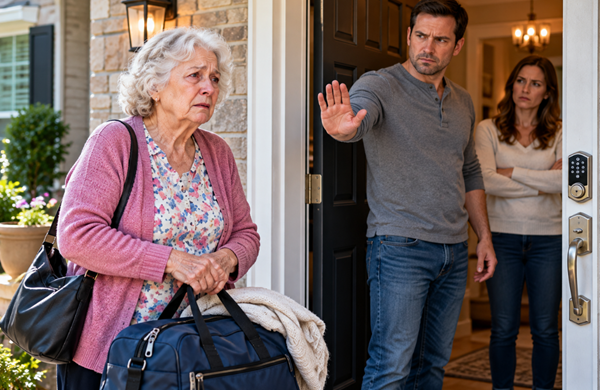
The Door That Changed Everything
At seventy years old, Eleanor Brooks believed she had already experienced the hardest chapter of her life.
She had buried her husband, Thomas, after forty-three years of marriage. She had spent sleepless nights learning how to live alone, drinking coffee from the same chipped mug he had used every morning, and resisting the urge to call out to him whenever something broke around the house.
Then came her unexpected hospital stay.
After several days of treatment, Eleanor was finally ready to return home. She expected a quiet evening, a warm blanket, and perhaps a familiar voice asking whether she needed anything.
Her son, Daniel, had promised to collect her.
But as the afternoon passed, he never arrived.
After several unanswered calls, a kind hospital employee helped Eleanor arrange a ride home.
She kept making excuses for her son during the journey.
Perhaps he had been delayed at work. Maybe his phone had stopped working. Surely there was a reasonable explanation.
She wanted to believe that.
When the car pulled into her driveway, she noticed Daniel’s vehicle parked beside the garage. Her daughter-in-law’s car was there, too.
Relief washed over her.
At least they were home.
Then Eleanor reached for her key.
It wouldn’t turn.
She looked closer at the front door. The familiar lock had been replaced with a modern keypad.
Before she could knock, the door opened.
Daniel stood in the doorway, looking irritated rather than pleased to see her.
“Mom, what are you doing here?” he asked.
Eleanor stared at him.
“What do you mean? This is my home.”
He glanced over his shoulder before stepping outside.
“Things have changed while you were away. Jessica and I have decided we need the house for ourselves. You should arrange somewhere else to stay.”
For a moment, Eleanor thought the medication had left her confused.
She had lived in that house for decades. She had raised Daniel there, celebrated birthdays in its kitchen, and held Thomas’s hand in the living room during his final days.
Now her own son was telling her she no longer belonged.
“Where am I supposed to go?” she whispered.
Daniel shrugged.
“That’s not my problem anymore.”
Behind him, Jessica appeared in the hallway. She said nothing. Her silence hurt almost as much as Daniel’s words.
Then Eleanor noticed a folded sheet of paper taped to the wall beside the entrance. It contained a short message telling her not to return.
She read it twice.
Her eyes filled with tears, but she refused to let them fall in front of them.
Instead, she picked up her small hospital bag and walked back toward the driveway.
Daniel assumed she had nowhere to turn.
He was wrong.
A Promise Her Husband Had Kept
Eleanor sat on a garden bench near the sidewalk and called someone she hadn’t spoken to in months.
His name was Michael Grant, the attorney who had helped her and Thomas organize their affairs years earlier.
When Michael answered, she struggled to explain what had happened.
He listened without interrupting.
Then he asked one question.
“Eleanor, did you ever sign anything transferring ownership of your house to Daniel?”
“No,” she replied. “Not that I remember.”
“Good. Please don’t argue with him or sign anything else until we’ve reviewed your documents. I’ll come to you.”
His calm voice gave her something she hadn’t felt since leaving the hospital: a little hope.
As she waited, Eleanor remembered a conversation from the previous winter.
Thomas had been growing weaker, but his mind remained sharp. One evening, while they sat beside the fireplace, he asked her to accompany him to Michael’s office.
“I want to make sure you’re protected,” he had told her.
She had laughed softly.
“Thomas, we’ve been married for forty-three years. What could possibly go wrong?”
He had taken her hand.
“Sometimes the people we love most are the ones we least expect to hurt us.”
She hadn’t understood his concern then.
Now, sitting outside her own home with a hospital bag beside her, she finally did.
The Documents Daniel Never Checked
Michael arrived carrying a briefcase and a folder of legal documents.
He greeted Eleanor warmly before examining the new lock and the message on the door.
“Let’s establish the facts first,” he said.
Inside his folder were copies of the property records, Thomas’s estate-planning documents, and other paperwork the couple had completed while Thomas was still alive.
Michael explained that the house had been legally transferred into Eleanor’s sole ownership several years earlier. The transaction had been properly recorded, and the documents were still valid.
Thomas had anticipated that disagreements might arise after his death.
He had wanted his wife to remain secure, regardless of what happened within the family.
Daniel apparently knew nothing about the transfer.
He had assumed that being the couple’s only child automatically gave him control over the family home.
It did not.
Michael also discovered troubling questions about financial documents Daniel had recently asked his mother to sign while she was receiving hospital treatment.
Those documents would need careful examination. Eleanor couldn’t be certain what she had signed or what Daniel had done with the paperwork.
Michael advised her not to confront him alone.
With Eleanor’s permission, he contacted the appropriate authorities and arranged for the property records to be reviewed.
For the first time that afternoon, Eleanor understood something important.
She wasn’t powerless.
She was exhausted, recovering from an illness, and deeply hurt by her son. But she still had rights, and she had people willing to help her protect them.
The Conversation at the Front Door
Later that day, Eleanor returned to the house with Michael and the appropriate officials.
Daniel opened the door with an expression of annoyance.
“What is all this?” he demanded.
Michael stepped forward and introduced himself.
“We’re here to resolve a matter concerning your mother’s property.”
Daniel folded his arms.
“This is my house now. Dad intended me to have it.”
Michael remained calm.
“Your father’s intentions are not the only issue. The recorded ownership documents establish that the property belongs to your mother.”
He presented the relevant paperwork.
Daniel took the documents and scanned them quickly. Then he began reading them again, more slowly.
His expression changed.
“That’s impossible,” he muttered.
“No,” Michael replied. “It’s documented.”
Jessica appeared behind him. When she heard the explanation, she looked from the papers to her husband.
“You told me the house was ours,” she said.
Daniel didn’t answer.
For months, he had spoken as if his father’s death had given him the right to make every decision. He had treated Eleanor’s presence as an inconvenience, forgetting that she had welcomed him into the home she owned.
Now the records told a different story.
Eleanor stood quietly beside Michael.
She had imagined this moment many times during the short drive back from the hospital. In some versions, she shouted at Daniel. In others, she demanded an apology.
But when she finally faced him, she discovered that she no longer wanted to argue.
She wanted him to understand what he had done.
“Daniel,” she said, “I didn’t expect you to give up your life to look after me. I never asked for that. I only expected you to treat me like your mother.”
His eyes dropped toward the floor.
“You left me at the hospital. You changed the locks while I was away. You told me to find somewhere else to live, without even asking whether I was well enough to manage on my own.”
He swallowed.
“I thought I was doing what Dad wanted.”
“You thought about what you wanted,” Eleanor replied. “And you never bothered to check whether you were right.”
Nobody spoke for several seconds.
The officials explained the next steps, and Michael made it clear that the property and any questionable financial transactions would be handled through the proper legal channels.
There would be no instant miracle. Records had to be reviewed, money traced if necessary, and responsibility established.
But Eleanor was no longer facing the situation alone.
The Letter Thomas Left Behind
That evening, Eleanor sat in her living room with a cup of tea.
The house was quiet again.
Michael had left her with a sealed envelope from Thomas’s personal papers, one he had asked her to keep until she felt ready to read it.
Inside was a short handwritten letter.
My dearest Eleanor,
If you’re reading this, I hope it’s because you need a reminder of something you sometimes forget.
You have spent your life caring for other people. You have forgiven mistakes, made sacrifices, and given more than anyone could reasonably ask of you.
But love does not require you to surrender your dignity.
I cannot promise that our family will always make the right choices. I can only ask you to remember that you deserve safety, respect, and a home where you feel welcome.
Whatever happens, please don’t confuse being kind with allowing yourself to be hurt.
You have always been stronger than you realize.
Forever yours,
Thomas
Eleanor pressed the letter against her chest.
For the first time that day, she cried.
Not because she was frightened, but because she finally allowed herself to grieve the loss of the life she had expected to have with her son.
She loved Daniel. That love hadn’t disappeared simply because he had hurt her.
But love could no longer be an excuse for ignoring what had happened.
A Different Kind of Beginning
Over the following weeks, Eleanor worked with Michael to secure her property records, review her finances, and establish clear boundaries with her family.
The investigation into the disputed paperwork continued through the proper channels. Eleanor learned to keep copies of important documents, seek independent advice before signing anything, and ask questions even when the person requesting her signature was someone she loved.
Daniel eventually sent a message asking to talk.
She didn’t answer immediately.
For years, she had believed that being a good mother meant always being available, always forgiving, and always finding a reason to excuse her son’s behavior.
Now she understood that reconciliation, if it ever happened, would require more than a few apologetic words.
It would require honesty.
It would require accountability.
And it would require time.
One spring morning, Eleanor stepped into her garden and began planting the flowers Thomas had always loved.
The soil was cool beneath her gloves. Birds moved through the branches overhead, and sunlight fell across the little wooden bench where she had once sat with her husband.
Her life was not the one she had imagined.
But it was still hers.
She had a home, a future, and the freedom to decide what happened next.
And perhaps that was the most important lesson Thomas had left her.
You can love your family without allowing them to take away your dignity. You can forgive someone without immediately trusting them again. And even when the people you love disappoint you, it is never too late to stand up for yourself.
Sometimes, the strongest response to betrayal isn’t revenge.
It’s choosing to protect your peace, one decision at a time.