 By Admin
For sixty years, Dolly Parton lived under some of the brightest lights in show business.
The towering wigs. The rhinestones. The laugh that filled every room she walked into.
But underneath all that shine was a woman who guarded her real life fiercely — and only let the world see what she decided to show.
It started with the image itself.
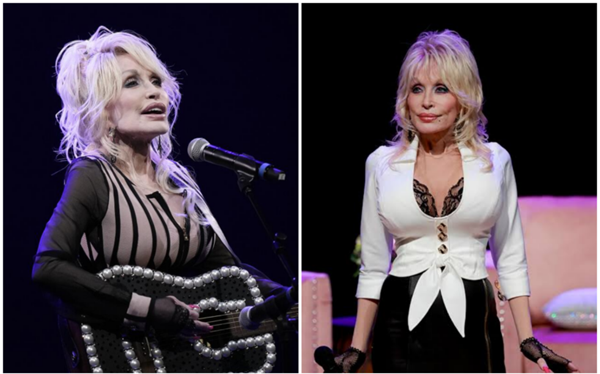
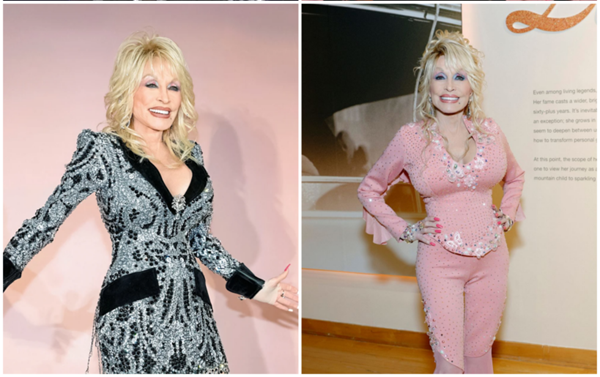
Dolly built that larger-than-life look on purpose. She stepped into country music in the 1960s, a world that wanted women quiet and unassuming — and she did the exact opposite. Bigger hair. Bolder color. A persona so loud it left no room for anyone else to define her first.
“It costs a lot of money to look this cheap,” she used to say. It sounded like a joke. It wasn’t really a joke.
Even her tattoos were part of that same quiet control.
She confirmed over the years that she had them — small, soft designs. Butterflies. Ribbons. A tiny beehive. Nothing rebellious.
Her skin scarred easily, and some of that ink covered marks left behind by medical procedures, including one from a feeding tube during a rough patch of illness. Comedian Jennifer Saunders once said she caught a glimpse of the artwork — and described it as more of a whisper than a statement.
Dolly herself brushed it off whenever it came up. “I’m not a tattoo girl,” she’d say. But turning a painful memory into something small and pretty was very her.
Her generosity worked the same way — mostly out of sight.
Her Imagination Library began as a small effort in her home county in Tennessee back in 1995. It’s since mailed hundreds of millions of free books to kids around the world. When wildfires tore through Gatlinburg in 2016, she quietly gave millions to help families rebuild. During COVID, she handed $1 million to Vanderbilt for vaccine research. She’s paid tuition for Dollywood employees without ever making it a headline.
She never wanted the “saint” narrative. She just called it giving back.
And behind the folksy warmth was a business mind sharper than most people realized.
She held onto her own publishing rights for her entire career — a decision that quietly made her a fortune when Whitney Houston’s version of “I Will Always Love You” became one of the best-selling singles ever recorded. Every royalty came home to Dolly.
She built Dollywood into an empire while letting her sweet, down-home charm make everyone underestimate exactly how calculated she really was.
Nowhere was that instinct for privacy stronger than in her marriage.
Carl Dean, who passed in March 2025 at 82, stayed married to Dolly for almost 60 years — and stayed almost completely invisible the entire time. No red carpets. No interviews. He went to one industry event with her early on and told her afterward: never again.
“We stayed married because I stayed gone,” she liked to joke. It wasn’t really a joke either. He gave her a private life. She gave him distance from a spotlight he never wanted.
She wasn’t always the picture of joy she performed, either.
In her 1994 memoir, she wrote candidly about depression and dark stretches in the 1980s — a rare admission for someone whose whole image ran on warmth. That tension, between the woman performing happiness and the woman sometimes fighting to feel it, shaped some of her best work. She wrote “Jolene” and “I Will Always Love You” almost back to back in the early ’70s — jealousy and heartbreak, both pulled from something real.
None of it was some scandalous secret life.
It was something quieter than that. A woman who understood early that fame takes whatever you let it — so she decided exactly what she’d give away, and what she’d keep for herself.
The wigs and the rhinestones were never a mask hiding someone fake.
They were armor for someone real — sturdy enough that she could give so much of herself to everyone else, and still have something left over that was only hers.