I Rekeyed My Own House While She Was At Church
I Rekeyed My Own House While She Was At Church
I rekeyed my own front door at 9:00 on a Sunday morning while my daughter-in-law sat in a pew three miles away. Then I made coffee, sat on the porch, and waited.
I thought the hardest part would be watching her key fail. I was wrong. The hardest part was what I found in the back seat of her car.
My name is Eleanor. I’m 83. I’ve lived in this house since 1971, when my husband Walter and I scraped together everything we had to buy it.
We wallpapered every room together. Walter built the hutch in the dining room with his own two hands. Our son, Marcus, took his first steps right there in that living room.
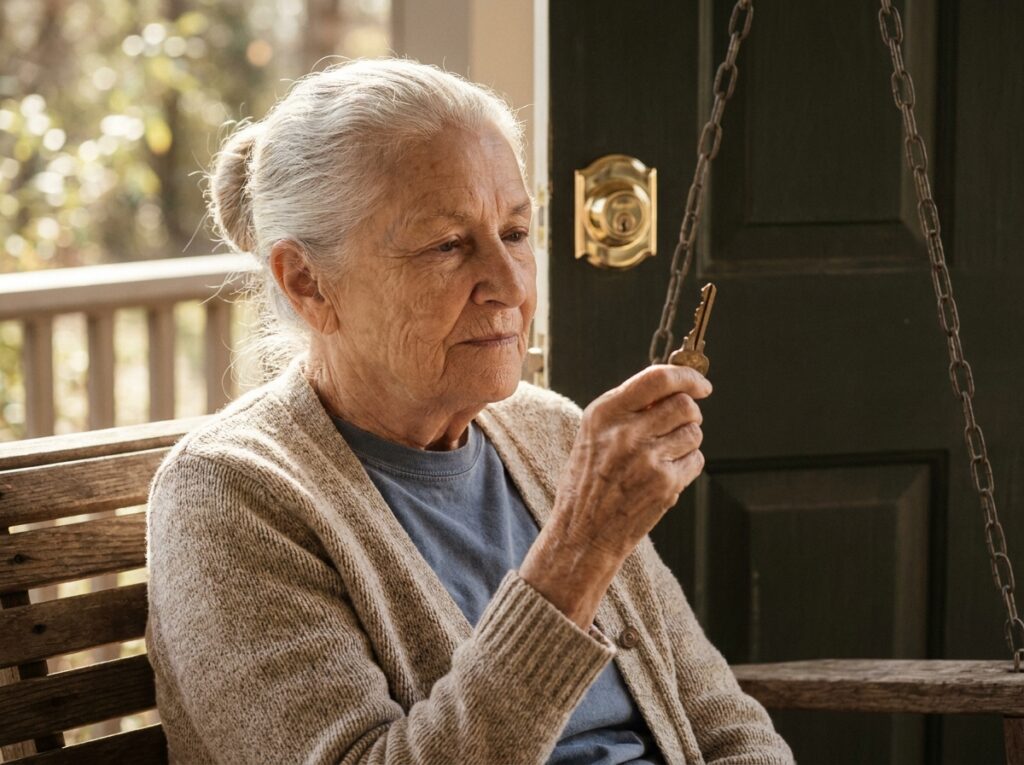
After Walter passed, this house got very, very quiet.
So when Marcus and his wife, Renee, asked to move in while they saved up for a place of their own, I said yes.
Six months, they told me.
They stayed three and a half years.
Marcus traveled constantly for work. That left Renee and me alone together most days. In the beginning, she seemed like a godsend — driving me to appointments, picking up my prescriptions, offering to “handle the boring stuff” like bills.
Slowly, helping turned into something else.
She started opening my mail before I saw it. Answering questions doctors asked me. She moved my important papers into a locked drawer in her office and told me not to worry about them anymore.
When I pushed back, she’d just smile.
“Let someone younger take this off your plate, Eleanor.”
Marcus always took her side.
“She’s just trying to make things easier for you, Mom.”
Eventually I stopped fighting it.
Renee mistook my silence for surrender.
About seven months before I rekeyed that door, my vision started failing. I could still make out faces and big block letters — but fine print turned to soup.
My mind, though? Sharp as ever.
I never told Renee how bad it had gotten.
Instead, I called my oldest friend, Marjorie.
Every Thursday I’d bring my mail to Marjorie’s kitchen table and she’d read it out loud to me. When Renee started leaving papers by my breakfast plate, those went to Marjorie too.
The first one Renee called a “Medicare form” was actually a durable power of attorney — handing her full control of my finances.
The second was a sworn statement claiming I was too confused to manage my own affairs.
The third was a deed transferring my house straight to Marcus, effective immediately.
I signed none of it.
Marjorie put me in touch with an elder-law attorney, Diane Foster.
Diane had me undergo a full medical evaluation. The doctor confirmed my eyesight was going — but my mind was completely intact.
She flagged fraud alerts on every account I had, and warned the county not to record any property transfer without confirming it with me directly, in person.
She told me to write everything down.
So I did. Every opened envelope. Every moved document. Every whispered comment about how “forgetful” I’d become.
Some part of me still hoped I was wrong about her.
Then one Sunday afternoon, walking my walker down the hallway, I heard Renee on speakerphone in the kitchen with her sister, Dana.
“The paperwork’s almost done,” Renee said. “Marcus signed the affidavit Tuesday.”
“And Eleanor has no clue?”
“She thinks it’s insurance stuff.” Renee laughed. “She can’t read fine print anymore, and she’s too stubborn to admit it.”
I froze behind the wall.
“What about the house?”
“Once the deed’s recorded, it’s Marcus’s. Then we list it.”
“And Eleanor?”
“I already put a deposit down at Brookhaven. We’ll tell her it’s short-term rehab. Once she’s in, we make it permanent.”
“Does Marcus know?”
“He thinks it’s for her safety. He signs whatever I hand him.”
I went straight to my room and called Diane.
By morning, she’d already tracked down copies of everything Renee had tried to file.
Marcus’s signature was on an affidavit supporting a guardianship petition — claiming he’d personally witnessed me becoming confused and incapable.
We had never once discussed that.
Diane filed an emergency petition using the falsified paperwork, my medical evaluation, and my own sworn account of that phone call.
By the end of the week, the court gave me temporary, exclusive possession of my own home. Marcus and Renee could collect their things later, under supervision — but couldn’t come inside without my say-so.
Sunday morning, a locksmith named Ray Bennett swapped out both exterior locks.
He handed me the new keys.
“I can stick around a bit,” he said.
“You don’t have to.”
“I know.”
Renee got home from church at 10:30. Pale blue dress, folded church bulletin in hand. She walked right past me like I was part of the porch railing.
“Morning,” I said.
She didn’t even glance up.
She jammed her key into the lock.
Nothing.
She tried again, harder.
“Eleanor, the door’s stuck.”
“The door’s fine.”
She turned around slowly. “What did you do?”
“I changed the locks.”
Her jaw dropped. “You can’t lock me out. I live here.”
“You stayed here,” I said. “There’s a difference.”
Her face shifted fast — anger, then that fake, syrupy concern.
“You’re confused again. I’m calling Marcus.”
“Go ahead. His key won’t work either.”
“You’re having an episode.”
“I’m having a Sunday.”
She stormed back to her car to make the call.
That’s when I saw her back door hanging open.
A moving box sat on the seat.
Inside it: my mother’s silver chest. Two engraved pheasants on the lid. It had sat in that dining room hutch for nearly fifty years — my mother gave it to me on my wedding day.
Underneath it, a thick folder.
Across the front, in letters big enough even I could read them:
FOR SALE.
I made my way down those porch steps as fast as my hip allowed and grabbed the folder before she could stop me.
“Don’t touch that,” Renee snapped.
I opened it anyway.
I couldn’t read the small print. But I didn’t need to. Photos of every room in my house. A realtor’s logo. My address. An inventory sheet — with a photo of my silver chest right on top.
She hadn’t just planned to take my house someday.
She’d already started sorting my life into keep and sell.
“Give it back,” she demanded.
“No.”
“You don’t understand what you’re looking at.”
“I understand my things were sitting in your trunk.”
“You can’t live in that house forever.”
“That’s not your call to make.”
She stepped in close. “You were eavesdropping on a private conversation.”
“No,” I said. “I was walking through my own house.”
For the first time, I saw fear on her face.
Not guilt.
Fear.
Marcus pulled up about forty minutes later, already irritated.
“Mom, what’s going on?”
“Your wife was preparing to sell my house out from under me.”
His face went hard. “That’s not possible.”
I handed him the folder.
He read in silence. Then he hit a printed email and stopped cold.
“What’s it say?” I asked.
His voice shook. “‘Once the deed’s recorded, move fast. Eleanor should be at Brookhaven before we start showing the house.'” He flipped the page. “‘This one says pull the silver before staging.'”
I looked back toward her car.
Marcus kept reading — until he landed on the affidavit with his own signature.
The color drained out of his face.
“Is that your signature?” I asked.
“Yes.”
“Did you read it before you signed?”
He looked at the ground. “No.”
“What did she tell you it was?”
“Paperwork about you needing help with insurance. Appointments.”
“You signed a legal statement about my mental state without ever talking to me.”
“I didn’t know.”
“You didn’t ask.”
Renee crossed her arms. “Marcus, she’s twisting all of this.”
I pulled out my medical evaluation and the court order and handed them over. “My mind is fine. The deed is blocked. Brookhaven canceled the room. And neither of you is allowed in my house.”
Renee stared at the papers. For months she’d counted on my failing eyes to make me powerless.
She never once imagined I’d been quietly protecting myself the whole time.
Then my phone chimed.
A fraud alert from my bank.
A $38,000 transfer, scheduled out of my savings account.
I showed it to Marcus. His eyes cut straight to Renee.
“What did you do?”
She grabbed her purse. “I was protecting our future.”
“By stealing from my mother?”
“It would’ve come to you eventually anyway.”
“I’m still alive,” I said.
The transfer never went through — Diane had already locked the account down. The bank was closed Sunday, so we sat down with the branch manager, Mr. Palmer, first thing Monday.
He slid a document across the desk. “This power of attorney was filed electronically Friday. The transfer was set to process today.”
He pointed to the signature. Close to mine. Not quite. A few letters off — copied from an old check.
“The fraud alert is what stopped it,” he said. Then he opened a second file. “There’s something else.”
For the past year and a half, Renee had used the debit card I’d given her strictly for groceries and my prescriptions.
She’d spent almost $22,000 of it on herself.
Marcus stared at her. “Why?”
Her composure cracked. She admitted to nearly $90,000 in hidden debt — credit cards, secret loans, a bad investment gone worse. She’d planned to bury it all under my savings and a fast sale of my house before Marcus ever found out.
“I was trying to save our marriage,” she sobbed.
“No,” Marcus said quietly. “You were destroying my mother to cover your lies.”
That was the moment he finally saw her clearly. Not the devoted wife he’d defended for years. The woman who had used his trust, his signature, and my age as a weapon.
The weeks after were rough. Renee packed up under supervision and never set foot in my house again. The forged documents, the unauthorized spending, the attempted transfer — all reported. The deed was thrown out. My money stayed exactly where it belonged.
Marcus got an apartment. Filed for divorce not long after.
I never told him to leave her. That was his to decide.
All I said was, “I don’t want revenge. I want accountability.”
A few days after the bank meeting, he came and sat with me on the porch.
“I should’ve listened to you,” he said.
“Yes.”
“I should’ve read what I signed.”
“Yes.”
“I should’ve protected you.”
I looked at him. “Yes.”
His eyes filled up. “Can you forgive me?”
“I love you,” I said. “But forgiveness and trust aren’t the same thing.”
He nodded. “I’ll earn it back.”
And over the months that followed, he tried. He called before dropping by. He actually listened instead of talking over me. He stopped treating every little disagreement as proof I was losing it.
Diane helped me put the house in a protected trust. Marcus can inherit it one day — but he can’t sell it, transfer it, or borrow against it while I’m alive.
My mother’s silver chest went back in the hutch, right where it belonged. Inside: old family photos, letters, my mother’s brooch, and a birthday card Marcus made me when he was seven.
A year to the day after I rekeyed that door, Marcus brought coffee and sat beside me on the porch.
“Mom,” he said, “are you happy?”
Nobody had asked me that in years. Plenty of people asked if I was safe. If I’d taken my pills. If I needed help.
Nobody asked if I was happy.
I looked out at the maple tree Walter and I planted together, the roses along the porch, the new lock gleaming on my front door.
“Yes,” I said. “I am.”
That Sunday morning, I thought I was changing locks to protect a house.
I was protecting something bigger than walls and furniture.
I was protecting my dignity.
Renee thought my age made me easy to erase.
She was wrong.
I may walk slower now. I may need help with small print.
But I still have my mind. My voice. And the right to decide my own life.
I didn’t fight just to keep my house.
I fought to stay a person inside it.
And for the first time in years, I finally felt all the way home.
Related Posts
-
 5 Subtle Signs an Elderly Person May Be in Their Final Year – Important Warnings You Shouldn’t Overlook
-
 He Sold the Home He Had Built With His Own Hands So His Granddaughter Could Become a Doctor… Years Later, She Pretended She Didn’t Know Him
-
 The Importance of Friendship in Our Love Story
-
 Our Love Story: When a Chance Encounter Changed Our Lives Forever
About The Author