 By Admin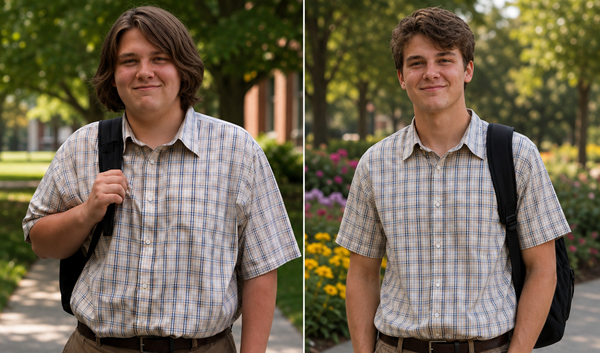
I saw one text on my son’s phone — “You still in?” — and I decided I had to stop him before morning. By the next afternoon, I found out what my locked door never could have.
I locked my son in our house the night before his second year of high school. I thought I was protecting him.
The kitchen light in our house always came on before sunrise. I liked it that way. I liked knowing where everyone was, what the day held, whose lunch went in whose bag.
That September, Caleb started ninth grade, and I promised myself I’d be a mother who stayed close. My sister Paula said I was already too close. I told her she didn’t have a teenager yet, so her opinion didn’t count.
Caleb came downstairs that first morning, hair a mess, wearing a smile that hadn’t yet learned to be embarrassed.
“Big day,” I said. “You grab the folder I set out?”
“Yeah, Mom.”
“Water bottle? The green one, not the one that leaks.”
“You feel picked.”
“Yeah, Mom.”
“And you know where your first class is? It’s clear on the other side of—”
“Mom. I’ve got it.”
He had it. He always had it, in the language we shared.
For the first few weeks, though, he came home chattier than he’d been since middle school. There was a girl. Her name was Sadie.
“She’s got this laugh,” he told me one night, hovering in the pantry doorway with a granola bar he wasn’t eating. “She doesn’t even try to be funny, she just laughs at what other people say, and you feel picked.”
“Picked?”
“Like — chosen. To laugh with.”
“That’s sweet.”
I smiled at the fridge so he wouldn’t catch me smiling at him.
He spent one entire Saturday at the kitchen table, a shopping tab open, agonizing over a small gift. A keychain shaped like a fox, because she’d once mentioned liking foxes.
“Is this stupid?” he asked.
“It’s sweet.”
His face went blank.
“So that’s a yes.”
“It’s sweet, Caleb.”
That night I told my sister Paula every detail, whispering like I’d cracked a code. I told Denise, whose son was in Caleb’s grade. I told the woman who cuts my hair.
He came home the following Thursday, backpack sliding off one shoulder, face wiped clean of everything.
“Did you see Sadie today?”
“Hey,” I said. “How was—”
“Fine.”
“Caleb, honey, did something—”
“Going upstairs.”
He stopped on the third step. Didn’t turn around.
“She laughed,” he said. “At my clothes. In front of everybody.”
“Was she alone?”
“No. Marcus and his friends were there. She only went after my clothes. They went after everything — my face, my body, my weight. Marcus started it.”
He didn’t touch a bite of dinner. Then his door clicked shut, gently, which was somehow worse than a slam.
I stood at the bottom of the stairs with a hundred questions stacked in my throat. Upstairs, I heard him sit down on his bed. I didn’t go up.
Freshman year kept unraveling in ways I told myself I wasn’t seeing.
Caleb came home every afternoon and went straight to his room. The oversized hoodie stayed on even at the dinner table.
One Tuesday I made his favorite, spaghetti. He sat with his sleeves pulled down over his hands, fists curled inside them like mittens, elbows tucked tight, making himself smaller than the chair.
“How was school?”
“Fine.”
He pushed the noodles around. Didn’t lift a bite.
“Did Marcus bother you again?”
“I’m fine, Mom.”
“You’re not eating.”
“Ate after practice.”
He hadn’t been to practice. I watched him tug his sleeves down and told myself he was cold.
“May I be excused?”
“You barely touched it.”
“Not hungry.”
I let him go.
I called Paula instead of sitting on the edge of his bed.
“He barely looks at me anymore, Paula. He used to talk my ear off.”
“Have you asked him? About Sadie, about Marcus — by name?”
“I ask him everything.”
“You ask if he’s okay. That’s not the same thing.”
I brushed her off. I was the one who showed up, who tracked report cards, who had the pediatrician’s number memorized. That was love. It had to be.
Then summer came, and something in my son loosened.
He started running mornings. Asked me to buy chicken and rice instead of frozen pizza. Came home from the barber with a real haircut and stood up straighter in the mirror.
“You look good, sweetheart.”
“Thanks, Mom.”
For a few weeks I let myself breathe. My cheerful boy was coming back.
Then the laptop started staying open past midnight.
I walked into his room with a stack of folded laundry, and he angled the screen away so fast the hinge creaked.
“What are you working on?”
“Need to finish something.”
“Finish what?”
“Just something, Mom. Please.”
He said please like he was shutting a door.
School started again, and Caleb only got harder to read. He guarded his phone, stayed up later, went vague whenever I asked what he was working on.
So I did something I swore I’d never do. I picked his phone up off the counter while he was in the shower, and I looked.
There was a thread with someone named Sadie.
Sadie — the girl who’d laughed at his clothes in front of the whole hallway. The girl I’d quietly blamed for every silent dinner in this house.
The messages were short.
Sadie: Can you talk later? Caleb: Yes. Sadie: You sure about this? Caleb: I’m sure.
I set the phone down. My hands went cold.
I called my sister from the garage.
“He’s talking to her, Paula. The one who started it.”
“Okay. And?”
“And he’s up till two on that laptop, hiding the screen, won’t tell me anything.”
“Ask him.”
“What if she’s using him? What if they’re planning something? What if someone’s putting him up to it?”
“Ask. Him.”
I didn’t. I built theories instead. I read articles about grooming, online manipulation, kids pulled into things their parents never saw coming. Every headline handed me a new fear: something was happening, and I was the last to know.
I ran into Denise outside the grocery store that afternoon, wearing that particular brightness moms get right before they hand you a grenade wrapped in tissue paper.
“Did you hear what Caleb did this morning?”
My stomach dropped. “What did he do?”
“He walked right past Marcus and his friends. None of them recognized him.”
“He’s changed a lot this summer,” I said. “Lost weight, got in shape, new haircut. He’s really grown up.”
Denise lowered her voice.
“He realized they didn’t recognize him. So he turned around, looked Marcus straight in the eye, and said, ‘You’ll get what’s coming to you.’ Then walked off.”
I drove home with my hands locked on the wheel, that sentence looping in my head. What’s coming to you. What did he mean by that? It didn’t sound like confidence. It sounded like a warning.
That evening I stood in his doorway with a mug of tea I’d made as an excuse. He was typing, his face lit blue.
“So — what happened with Marcus today?”
“Nothing.”
“Denise told me what you said to him.”
He looked up. For a second his face opened, like he might explain.
Then he saw whatever was on mine, and the shutter dropped again.
“It’s nothing, Mom.”
I carried the tea, untouched, back to the kitchen and told myself tomorrow I’d finally get an answer.
That night the notification lit up his phone while he was in the shower.
You still in?
Three dots. Then his reply: Tomorrow.
I read it twice. A third time. Until tomorrow stopped meaning anything except danger.
When Caleb came downstairs, I was already at the table, his phone face-down between us.
“Sit.”
“Mom, what—”
I slid the phone across.
“Someone asked if you were still in. You said tomorrow. In on what, Caleb?”
Something in his face shut down.
“It’s nothing.”
“It is not nothing. I’ve watched you all summer — the laptop, the late nights, hiding the screen. And now Denise tells me you looked Marcus in the eye and told him he’d get what was coming. What am I supposed to think?”
“Tell me what you think I’m doing. Say it.”
I couldn’t. Every version I’d rehearsed sounded insane out loud. So I did what I always did. I listed.
“I think that girl’s involved in something. I think you’re getting pulled into something you don’t understand. Something that could ruin your life, or—”
“Stop.”
“Caleb.”
“You never listen.” He shot up so fast the chair scraped the floor. “You just decide what’s happening and panic about it. All year. All summer. A hundred questions a day and none of them are real questions.”
“They’re not questions, Mom. They’re inventory. You check that I’m here, then go worry somewhere else.”
“Sit down.”
“No.”
“You are not leaving this house.”
And suddenly I saw it — blood, police lights outside the school, Caleb, Marcus. One thought swallowed everything: if he walked out that door, someone was going to get hurt.
So I did something I never imagined myself doing. His bedroom was upstairs, and the old lock on the door only worked from the hallway, with a key. Once turned, it couldn’t be opened from inside.
I waited until he went in, pulled the door shut, and turned the key.
“You’re not leaving until I understand what’s going on,” I said through the wood.
Nothing. No shouting. No fists on the door. Just silence.
I sat in the hallway until two in the morning, listening for movement. There wasn’t any. Eventually I fell asleep against the wall.
When I woke, the door was still locked. But the window was open. I rushed in — fresh scuff marks streaked the porch roof below the sill.
Caleb was gone.
I called his phone. Voicemail. Called again. Voicemail. Texted where are you, then please, then just a question mark, watching for a read receipt that never came.
I called Paula and heard myself saying he’s gone, he’s gone, and she said, “Breathe. Tell me what you know,” and I realized I knew nothing, which was the entire problem.
I called Denise. She’d just dropped her daughter off at school.
“Did you see Caleb there?”
“No. I didn’t.”
My stomach fell out from under me.
I opened his laptop, desperate for any clue.
Folders. Dozens of them. Dates. Screenshots of messages I could barely stand to read — words about his body, his face, his weight. Photos of bruised knuckles. A spreadsheet, names down one column, dates down the other.
Marcus’s name, over and over.
And one folder, set apart, labeled SADIE.
Inside: documents, statements, something that looked like the draft of a proposal. None of it stitched into a shape my brain could hold.
Then the phone rang.
“Mrs. Ferris? This is Ms. Ortiz, at the high school. You need to come in. Now.”
I grabbed my keys and ran for the car, certain I was already too late.
I burst through the school’s front doors expecting sirens. Instead, a receptionist walked me calmly to a conference room.
Caleb sat at the table beside Ms. Ortiz, a counselor, and a girl I didn’t recognize.
“Mom, this is Sadie,” Caleb said.
“Mrs. Ferris, please, sit,” Ms. Ortiz said. “Your son has brought us something remarkable.”
Spread across the table: folders. Screenshots. Dated logs. Photos of bruises. The same material I’d just found on his laptop.
“What is this?” I whispered.
“Evidence,” Caleb said. “About Marcus. What he did to me, to Sadie, to half this school.”
“I laughed with them last year because I was scared,” Sadie said. “Marcus and his friends had already spent months on me. That day, when they turned on Caleb, I knew if I didn’t laugh too, they’d come back for me.”
She looked at Caleb.
“He noticed they treated me differently when no one else was around. He figured it out before I had the nerve to tell anyone. He messaged me over the summer.”
“The text,” I said. “Tomorrow. I thought—”
“I know what you thought, Mom.” His voice was steady. “Today was the day we presented all of it. We want to start a peer support group. So nobody carries this alone.”
Ms. Ortiz rested a hand on the folders.
“The principal has everything now. Marcus won’t be in class while the school investigates.”
Sadie’s hands were shaking. She pressed them flat on the table, then tucked them under her legs. No one filled the silence.
I turned to my son, my own hands trembling on the table’s edge.
“I’m sorry I didn’t listen.”
He didn’t answer right away. Just nodded, once. That was worse than anything he could have said.
In the car, we drove with the radio off. I gripped the wheel until my knuckles ached.
“Caleb,” I finally said. “Tell me what this year was really like.”
I waited. I didn’t fill the quiet. I didn’t stack another question on top of it.
He started talking. Slowly, then not.
The running, he said, was the only time his head went quiet. The haircut, the food, all of it — his way of taking back the small things Marcus had made him hate about himself.
“I wasn’t trying to become someone else,” he said. “I just wanted to feel like myself again.”
I’d been so afraid my son would stop talking to me that I never noticed I’d already stopped listening.
So this time, I listened. All the way home.