 By Admin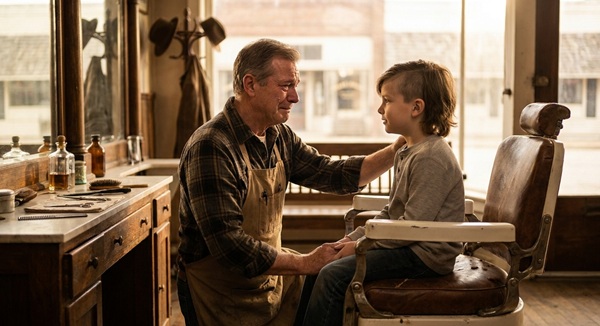
Ever since Tyler was four, Mr. Lewis had been the only barber his mother trusted with his hair. The shop was small and welcoming, just three blocks from their house. Mr. Lewis knew Tyler’s favorite baseball team, remembered which players he liked, and always kept grape lollipops behind the counter for him.
Tyler loved going there.
He even had his own routine.
He would climb into the chair, choose the music, talk about baseball, and tell Mr. Lewis everything that had happened during the week.
So when Tyler’s mother recently decided he was old enough to walk to the barbershop by himself, she felt comfortable.
It was only three blocks away.
She saw it as a small step toward independence.
That Saturday morning, Tyler left home for his haircut just like he always did.
About an hour later, he walked back through the front door.
His mother looked at him—and immediately froze.
Only half of his hair had been cut.
The entire right side was short and neatly trimmed.
The left side was still long.
For a moment, she simply stared at him.
“Tyler… what happened to your hair?”
Her son shrugged.
“Mr. Lewis stopped.”
That was all he said.
His mother waited for him to laugh or explain.
Nothing came.
That frightened her more than the strange haircut.
Tyler was normally the kind of child who talked nonstop after visiting the barbershop. He would tell her what music they played, what he and Mr. Lewis discussed, and whether the barber had remembered his favorite lollipop.
But now he was unusually quiet.
His mother immediately called the barbershop.
She expected to hear something ordinary.
Maybe the clippers had stopped working.
Maybe Mr. Lewis had accidentally cut something incorrectly.
Maybe there had been an emergency and he had needed to leave.
Instead, when Mr. Lewis answered the phone, his voice sounded broken.
He was crying.
“I’m sorry,” he said.
Tyler’s mother became even more worried.
“What happened? Is Tyler okay?”
“Yes,” Mr. Lewis replied. “He’s okay. I just… I couldn’t finish his haircut.”
There was a long pause.
Then he asked them to come back to the shop.
“I need you to see something,” he said.
He wouldn’t explain anything else over the phone.
Tyler remained silent as his mother took his hand and walked with him back toward the barbershop.
With every step, her imagination became worse.
She kept wondering what could possibly have happened.
Had Tyler been hurt?
Had someone entered the shop?
Had there been some kind of accident?
When they reached the barbershop, something immediately felt wrong.
The door was locked.
The sign said the shop was closed.
It wasn’t even noon.
Mr. Lewis eventually opened the door for them.
And the moment Tyler’s mother stepped inside, she understood why the barber had been crying.
Mr. Lewis had been struggling with serious problems in his personal life.
He had been dealing with financial pressure and painful family difficulties, problems he had kept mostly to himself. He had continued showing up to work, greeting customers, cutting hair, smiling, and pretending that everything was fine.
But that morning, something had finally broken through.
While Tyler was sitting in the chair, Mr. Lewis became overwhelmed.
He tried to continue cutting the boy’s hair.
But Tyler noticed that something wasn’t right.
He noticed the barber’s hands.
He noticed his expression.
He noticed the tears.
And instead of complaining about his haircut, Tyler asked if Mr. Lewis was okay.
The question was simple.
But for a man who had been carrying his problems quietly, it meant everything.
Tyler didn’t make fun of him.
He didn’t become impatient.
He didn’t ask why the barber was crying in front of him.
He simply tried to comfort him.
He offered the kind of help and reassurance that an eight-year-old could give.
Mr. Lewis became so emotional that he had to stop cutting.
He couldn’t safely continue with the clippers while struggling to control his emotions.
That’s why Tyler came home with only half of his hair finished.
His mother looked at her son.
Then she looked at Mr. Lewis.
And suddenly the strange haircut didn’t matter anymore.
What she had initially thought was a disaster was actually the result of her son showing compassion to an adult who was hurting.
But there was something else that made her even more surprised.
Tyler had known that Mr. Lewis’s problems were private.
That was why he hadn’t told her everything on the walk home.
He didn’t want to embarrass the barber.
He didn’t think it was his story to tell.
For an eight-year-old, that showed an extraordinary amount of understanding.
His mother had expected her son to come home with a funny story about a haircut gone wrong.
Instead, he had come home carrying a quiet lesson about kindness, privacy, and empathy.
The family decided they couldn’t simply walk away after learning what Mr. Lewis had been going through.
They offered practical help and made sure he wasn’t left completely alone with his problems.
They reminded him that he didn’t have to carry everything by himself.
Their help couldn’t magically fix every financial or family difficulty, but it gave Mr. Lewis something he had been missing.
Someone noticed.
Someone cared.
Someone was willing to stop and listen.
Eventually, when Mr. Lewis felt ready, he finished Tyler’s haircut.
The two of them laughed about the unusual hairstyle.
But by then, everyone understood that the haircut was no longer the important part of the story.
The unfinished hair had become a reminder of something much bigger.
Tyler’s mother had allowed her son to walk to the barbershop because she wanted to teach him independence.
She never expected that the experience would teach her something about the kind of person he was becoming.
Parents often teach children to be careful.
They teach them to follow rules.
They tell them what to do when something feels dangerous or uncomfortable.
They teach them to ask trusted adults for help.
But there is another lesson children learn by watching the adults around them.
They learn how to treat people who are struggling.
Tyler could have focused entirely on himself.
He could have complained that his haircut was unfinished.
He could have demanded that Mr. Lewis fix it.
He could have laughed at the barber for crying.
Instead, he saw another human being who was hurting.
And he chose kindness.
That choice mattered.
It didn’t solve Mr. Lewis’s problems.
It wasn’t Tyler’s responsibility to solve them.
But his compassion reminded the barber that he wasn’t invisible.
And that can sometimes be the first step toward asking for help.
The experience also reminded Tyler’s mother of something important.
Children should be encouraged to care about others, but they should never be expected to carry adult problems on their shoulders.
Tyler could be proud of the kindness he showed without becoming responsible for Mr. Lewis’s future.
Adults needed to step in.
Adults needed to provide practical support.
And if Mr. Lewis needed professional assistance, that responsibility belonged with trusted adults and appropriate professionals—not with an eight-year-old boy.
Tyler had done what he could.
He noticed.
He cared.
He protected Mr. Lewis’s dignity.
And he showed compassion when it would have been easier to think only about himself.
His mother had gone pale when she first saw him standing in the doorway with half his hair still long.
She thought something terrible had happened.
Instead, she discovered something that made her deeply proud.
Her son had come home with an unfinished haircut.
But he had completed something much more important.
He had shown what kindness looks like when it actually matters.
And years later, his mother would probably remember that Saturday morning not because of the strange haircut, but because it was the day she realized that her little boy was beginning to understand something many adults spend a lifetime learning:
Sometimes, being a good person means noticing someone else’s pain before worrying about your own inconvenience.